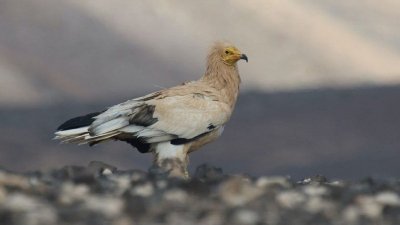
A pair of Egyptian vultures, also known as guirres, has once again reproduced in Timanfaya National Park. In 2022, the guirre nested for the first time in this protected natural area after more than twenty years of absence. The same pair of guirres, which nested again in 2024, has reproduced again.
The guirre is the only strictly scavenger raptor in the entire avifauna of the Canary Archipelago and the vernacular name that the aboriginal Canarian population gave to the Egyptian vulture (Neophron percnopterus).
As reported by the Ministry of Ecological Transition, the news confirms "the incipient recovery" in Lanzarote of the population of this species, which in the 90s was on the verge of extinction due to the indiscriminate use of poisons and anthropogenic pressure.
In the words of the Minister of Ecological Transition and Energy of the Government of the Canary Islands, Mariano H. Zapata, "this is excellent news for the Canary Islands and for the conservation of our biodiversity." As he detailed, this event shows signs of a rebound in the recovery of this species on the island of Lanzarote, which complements the significant growth recorded in Fuerteventura in recent decades.”
Regarding this pair of guirres, their reproduction began in early January 2026 in the same breeding territory they chose two years ago. "In the early days of the year, the guirres dedicate almost all day to choosing the cave they will use for reproduction, bringing material to the nest, and reinforcing their relationship with joint flights and frequent copulations," details Walo Moreno, a field technician who has been studying the guirre on the ground for fourteen years, within the framework of the Monitoring Program promoted by the Directorate General of Natural Environment of the Government of the Canary Islands, currently co-financed by the Canarias FEDER 2021-2027 Program and with the scientific advice of the Doñana Biological Station of the Higher Council for Scientific Research (CSIC).
Incubation lasts 42 days and is the most delicate stage, shared almost equally by both members of the pair. The clutch is of a maximum of two eggs.
Affected by vehicle noise
The presence of noises originating from motor vehicles, loose dogs, and other human activities is perceived by this animal as a nuisance and has a fatal consequence: it causes the Egyptian vultures to abandon the nest, leaving the clutch unprotected, which has little chance of thriving without an adult controlling its exposure to temperature changes and defending it from predators. The first three weeks after the brood's birth are equally delicate.
“We have to concentrate our efforts on avoiding disturbances during this critical period,” say the experts. To achieve this, it is essential that, especially during the nesting season, we respect the signage, stay on the marked trails, and enjoy nature in silence.” With the collaboration of the citizens, “we will be able to see the chick flying with its parents seventy days after hatching.”
“The productivity rate of the Egyptian vulture is around 40%: out of ten monitored pairs that start reproduction, only four raise the chick,” details Walo Moreno. The causes of this low productivity are “multiple and insufficiently known,” although anthropic pressure in the breeding areas is one of the most relevant factors. Thanks to the Government of the Canary Islands and the Cabildos heeding the measures proposed by the research team that studied and diagnosed the conservation status of the Egyptian vulture, the population of this bird is recovering with 30 to 40 new specimens each year,” he adds.
In 2002, a study led by researcher José Antonio Donazar concluded that the Canary Islands population of Egyptian vultures was a new subspecies (Neophron percnopterus majorensis). The only vulture present in the Archipelago and in the entire Macaronesian region “is morphologically and genetically different from any other homologous population in the world,” presenting longer wings, a more robust build, and a stronger, more elongated beak, adapted to the aridity of the islands.
This subspecies has experienced a significant recovery throughout its distribution area, especially in Fuerteventura where its population has quadrupled. In Lanzarote, the recovery has been slower.
The importance of this bird is perceived in the toponymy of all the Canary Islands. In Lanzarote, it gives its name to one of the Calderas Quemadas, a line of volcanoes that follows the direction of the fissure that gave rise to the historic eruption of Timanfaya.


Add La Voz de Lanzarote as a preferred Google source.
Stay informed with the latest current news.