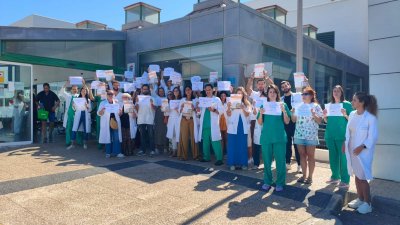
Doctors from the José Molina Orosa Hospital have joined the national strike called by the group to demand their own statute for their profession and labor and pay improvements. Specifically, 22.7% of doctors in the Canary Islands have supported the strike this Friday, a figure that the Medical Union (CESM Canarias) raises to 75%, according to data provided to EFE.
In a statement, the Ministry of Health of the Government of the Canary Islands has indicated that the call has registered a follow-up in the islands of 22.7%, which implies that it has been supported by 1,021 professionals, both from Primary Care and Hospital Care, of the 4,491 personnel affected.
The Ministry of Health has highlighted that, of the 2,144 specialist doctors affected by the call, 712 supported it; of the other categories of the A1 health group of Hospitalaria, 172 could have joined the strike and none did, while of the 866 doctors from health centers, a total of 81 Family and Community Medicine doctors joined the strike.
During another rally organized in front of the Government Delegation in Las Palmas de Gran Canaria, which was also held in the sub-delegation, in Tenerife, and at the doors of hospitals on the other islands, the Medical Union of the Canary Islands stated during the reading of the manifesto that they do not accept "a Framework Statute that cuts rights, ignores our demands and disregards our work."
### ### A Statute of Our Own Doctors have recalled that they have been demanding "something so basic" as their own Statute for years, "which recognizes our special conditions of training, dedication and responsibility," since **they are currently governed by the current Framework Statute that includes all healthcare personnel**.
In addition, they have described the Ministry of Health's preliminary draft bill as "a real attack on the medical profession and practitioners" and "a real disgrace."
The president of CESM Canarias, Eric Álvarez, explained to the press that the two main demands are the withdrawal of the draft Framework Statute "that the Ministry of Health has unilaterally put forward" and worsens the conditions, and a Framework Statute of its own that, in the case of the Canary Islands, takes into account its particularities as a peripheral region.
As an example, Álvarez pointed out that they are the healthcare professionals who do the most on-call shifts, and that this requires its own regulation, because right now the statute does not establish the number of on-call hours.
The union president has said that, especially on the non-capital islands, "there is a shortage of doctors generated precisely by the working conditions we have." "We have doctors on call every other day, which is unsustainable," he added, estimating that the Canary Islands are short approximately 30% of doctors, with significant deficits in specialties such as Family Medicine or Anesthesia. Álvarez also explained that doctors do not have overtime hours, and that the Statute calls them 'complementary', "a concept invented only for us in which, in addition, we are paid less than the ordinary hour.""It's really something unheard of, especially considering that the complementary hours are the on-call shifts, which also make up a large percentage of what we do, and it doesn't count towards retirement," she explained.
With signs that read 'No healthcare without doctors' or 'For decent working conditions', dozens of doctors have gathered in Las Palmas de Gran Canaria, a figure that, Álvarez warned, does not represent the real mobilization.
Many of the professionals who would like to be supporting the strike, he said, are performing the minimum services imposed, which are 100% for specialties such as Dialysis, Oncology, Pharmacy, or Emergencies, and others are taking the exams corresponding to the competitive examination for stabilization of the Canary Islands Health Service (SCS).
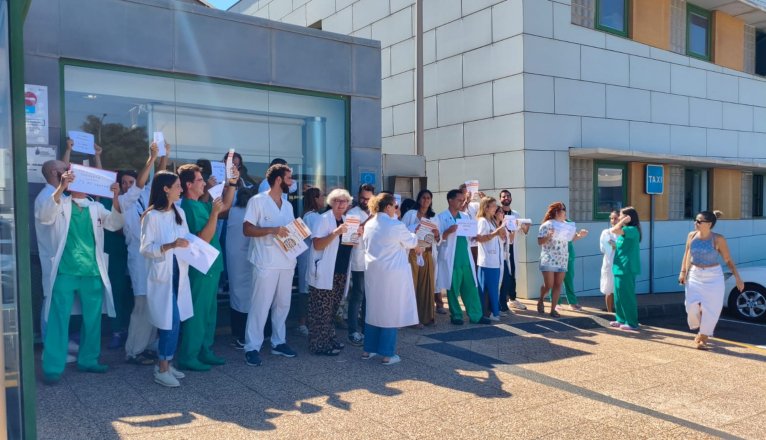
### Legislation not adapted to new professionals In Tenerife, the Secretary General of the Spanish Confederation of Medical Trade Unions of the Canary Islands, Levy Cabrera, explained that the current legislation has not been adapted to the "current scenario of professional skills," a situation that the reform proposed by the Government does not correct either, since it indicates "that all degrees are equal, and that is not the case." "One of the complaints is the reclassification of specialists at the level of studies that have to develop the requirement of being a specialist to work and then have a super-specialization within the specialty (...) That is why we ask for a reclassification with a remuneration according to each function, competence and responsibility that the profession has when practicing," Cabrera said. To which is added, he continued, the "issue of on-call shifts", since the time worked during them "does not count as time worked" and they demand that it should "count towards retirement" and be considered "like overtime", because they are "hours outside of ordinary working hours".
Finally, the union representative pointed out that another of their demands is that the selection processes to "make doctors permanent" in the National Health System have "become obsolete" and must be "efficient and agile" in order to "attract and retain talent" and so that specialists "do not flee to neighboring countries or to private healthcare."
This Friday's work shift has 1,227 personnel providing minimum services, which have passed "without notable incidents," according to the Ministry.
The president of the medical union has indicated that they are going to take legal action in those cases in which they have seen their right to strike violated by imposed minimum services, which he has described as "abusive" and "misapplied."
Regarding the duration of the strike, he said that, if necessary, they will begin to hold periodic stoppages or even a continuous indefinite strike.
Add La Voz de Lanzarote as a preferred Google source.
Stay informed with the latest current news.