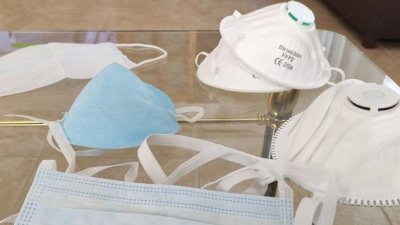
The mandatory mask in pharmacies, health centers and residences, could come to an end.
Fernando Simón, has advanced that the mandatory use of masks "will end soon." But he did not fail to emphasize that "it would not hurt" to keep it "a little longer" in health and social health centers. Although according to his forecast this measure is not going to "last too long".
"If we manage to maintain that culture of protecting others, I think this can be changed and that the mandatory use of masks will be eliminated soon," he summarized.
A few days earlier, coinciding with the end of this restriction in Portugal, the Madrid Health Minister, Enrique Ruiz Escudero, assured that the mask "necessarily should focus on the very vulnerable." The minister advocated for its use "in hospitals and health centers in an appropriate manner."
Also the Minister of Health, José Miñones, spoke about it. He limited himself to responding that his department will follow "the recommendations of the alert panel when making any decision," the communication agency reports.
Each Autonomous Community has different opinions about it. In the Canary Islands they are in favor of it being maintained in care centers, EFE reports. In Catalonia they believe that it should continue in health centers, more specifically, in hospital areas where people with infectious, respiratory and immunosuppressed diseases are treated. While in Euskadi and Ceuta the decision is alluded to "experts and technical and scientific committees" and Navarra believes that "the risks and benefits must be assessed in the "most refined way possible".
In addition, Cantabria thinks that it may be the time to eliminate them because "the pandemic is stabilized and it is possible to consider recovering more spaces of normality." And Andalusia recognizes that "we are still in a pandemic and now that there is a slight rebound "it is not precisely the time to debate whether to remove it or not."
But experts emphasize that "there still seems to be interest in continuing to maintain them", especially in health centers, as a way to "better protect vulnerable people."
Óscar Zurriaga, president of the Spanish Society of Epidemiology, recognizes to EFE that its use in some areas and not in others, would not make "compliance with its use more difficult."
The President of the Spanish Society of Internal Medicine, Juana Carretero, makes it clear that in hospitals in areas where patients are not directly cared for and in transit "it should no longer be mandatory." Although from the General Council of Pharmaceutical Associations they estimate that, despite the improvement of the situation, in these establishments they must "still be alert", they confirm to EFE.



Add La Voz de Lanzarote as a preferred Google source.
Stay informed with the latest current news.