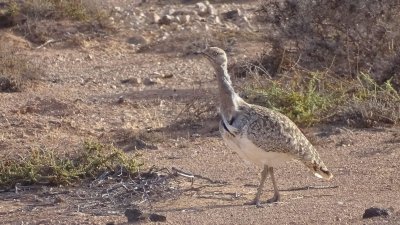
The scientific community and various environmental organizations have shown their concern and rejection regarding the celebration of the Tinajo Rally scheduled for this Saturday, April 11, considering that it poses a serious risk to the Canarian houbara, one of the most threatened birds in the Canary Islands.
Collectives such as SEO/BirdLife, Ecologistas en Acción Lanzarote, GREFA and Desert Watch warn that the Canarian houbara bustard is continuously present on the rally route. This species, cataloged as endangered, is currently in the middle of its breeding season, which increases its vulnerability to human disturbances. All this also occurs after a period of abundant rainfall that has favored the reproductive activity of the houbara bustard in the area.
Environmental organizations recall that scientific studies carried out in previous years —and presented to the Government of the Canary Islands— have identified numerous display points for Houbara bustard males along the planned route for next Saturday's Tinajo race. “It is not a sporadic presence, but a key area for the reproduction of the species,” they emphasize.
Added to this impact is the forecast of strong winds during the rally celebration. The dust raised by the cars and by the movement of the public can affect tens of meters around the tracks, causing a severe and persistent degradation of the vegetation, a fundamental base of the ecosystem. They also point out that “not only do competition vehicles bother. The continued presence of spectators, their circulation on the tracks, and the previous work of adapting the terrain with heavy machinery have already generated a significant impact”.
From the scientific field, Nigel Collar, emeritus chairman of the Bustard Specialist Group of the International Union for Conservation of Nature of the UN (IUCN), recalls that “the Canary Islands houbara is listed on the international Red List of threatened species. Therefore, he urges the authorities to provisionally suspend it so as not to harm the reproduction and conservation of steppe birds, classified as protected in the Canarian and Spanish Catalogues and to demand that organizers consult with conservation stakeholders about the exact timing and route of the rally in all its future editions”.
In the same vein, Alberto Ucero, doctor in Ecology and specialist in the Canarian houbara, warns that “this type of event generates high levels of noise, vehicle traffic and an influx of spectators that seriously alter their behavior, especially now in spring, during the breeding period, causing nest abandonment and breeding failure. Furthermore, intensive use of the territory can degrade key habitats and increase the risk of mortality. In a context of populations already at risk of extinction, avoiding this type of disturbance is fundamental to guarantee the conservation of the species and of Lanzarote's fragile steppe ecosystem.”
The groups insist that the affliction is not limited to this emblematic species. Other strictly protected species, such as the common stone-curlew, the cream-colored courser, and various raptors, use these same open habitats to feed and breed. One of the main problems is the trampling and the circulation and parking of vehicles in unauthorized areas, which cause the direct destruction of endemic flora and soil compaction, hindering its regeneration in an especially fragile ecosystem like that of Lanzarote.
For all this, scientists and environmentalists demand greater responsibility in the management of the territory and ask that the natural values of the area be taken into account before authorizing events that may compromise the conservation of unique species of the archipelago.



Add La Voz de Lanzarote as a preferred Google source.
Stay informed with the latest current news.