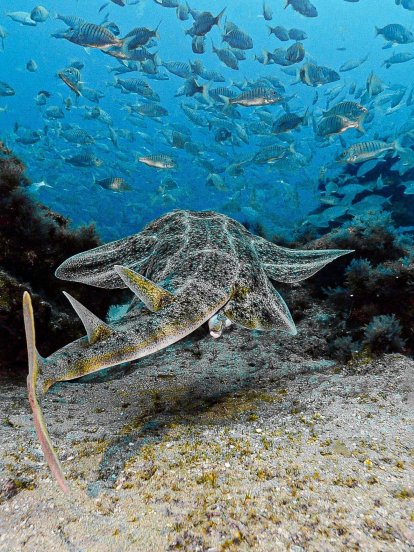
The documentary videographer Felipe Ravina has captured with his lens the spectacular seabed of La Graciosa. The documentary filmmaker has taken the opportunity to assess the importance of the second largest Marine Reserve in Europe, made up of the eighth island and the Northern Islets (Alegranza, Montaña Clara Roque del Este and Roque del Oeste) and which allows you to find countless species sailing on its crystal clear waters.
This protection measure "was created in 1995 and is the example that Marine Reserves work. While in many parts of the Canary Islands, the seabed is practically empty, in La Graciosa they are full of life," Ravina attests. In the images that he has made public through his Instagram account, where he already accumulates more than 100,000 followers, he shows a specimen of angel shark or angelote, a species in critical danger of extinction that has found in the Archipelago its only hope of surviving.
"Abundant fish populations benefit predators such as the angelshark, whose only stable population in the world is found in the Canary Islands," explains the expert.
"All the predators and key species, which are so difficult to observe in the rest of the Canary Islands, are easily found here," adds Ravina. La Graciosa is an exception that confirms that Marine Reserves are positive for biodiversity. The Archipelago "has lost around 90% of its fish in the last 60 years, so it is URGENT to create protected marine spaces, where fish populations can recover," Ravina tells La Voz.
Ravina, born in Tenerife and a graduate in Marine Sciences, is dedicated to preservation and awareness work, where he seeks to teach the population the value of preserving the seabed. Likewise, he already has more than 100,000 followers on Instagram, a space where he publishes videos and photographs of his underwater experiences.
For this documentary filmmaker, the presence of Marine Reserves is not only positive for the environment, but is also an attraction for "quality tourism in the form of thousands of divers who come to enjoy our nature. Finally, the recovery of the seabed also benefits the fishing sector that depends on the good health of marine ecosystems."
This scientist aspires to other islands joining in creating Marine Reserves on their coasts and adopting other effective protection methods that allow species that cannot be observed in other parts of the world to live in the Canary Islands.



Add La Voz de Lanzarote as a preferred Google source.
Stay informed with the latest current news.