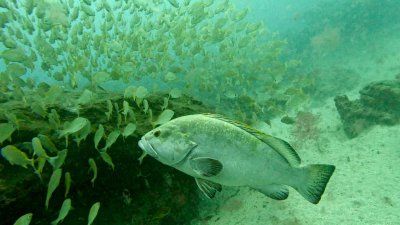
Researchers from the University of La Laguna and the General Directorate of Public Health of the Government of the Canary Islands have documented the first case in two decades of a ciguatera poisoning linked to a fish of barely 2 kilos, which breaks with the established biological norm that it is only found in dangerous levels in large predators.
A team of specialists led by Ana Hernández and Álvaro Torres, linked to the University of La Laguna and the Epidemiology and Prevention Service of the Directorate General of Public Health, has published the corresponding study, in a finding described by the authors as a scientific milestone because it breaks with the established biological rule that ciguatoxin is only found in dangerous levels in large predators.The investigation, which analyzes the evolution of this toxin in the archipelago between 2008 and 2025, focuses on an outbreak that occurred in June 2025 after consuming a barracuda (Sphyraena viridensis) purchased at a supermarket, a species that, due to its size, was not subject to current mandatory weight controls
According to Torres in a statement from the University of La Laguna, the accumulation of the toxin works similarly to other heavy metals in the marine ecosystem, as the substance concentrates as one moves up the food chain.
Thus, according to the researcher, “the toxin accumulates, it is not cleaned. It is like mercury; the bigger the fish, the more mercury, and the bigger the fish, the more toxin”.
Relevant toxicity
For this reason, detecting a relevant level of toxicity in a specimen of only two kilos is an out-of-the-ordinary event that motivated the publication of the study, given that, as the researcher points out, "what has happened is exceptional and hence the interest of the publication, because it is not the usual".Despite the relevance of the discovery, the researchers have sent a message of reassurance to the population regarding the safety of the food chain on the islands.Torres emphasizes that "one can continue to trust the systems we have perfectly," since the probability of finding fish with toxins outside of the usual controls is extremely low.In fact, the expert maintains that if the affectation in small fish were massive, the incidence of intoxication would be widespread in the population, something that surveillance figures categorically deny.The current protocols, which are continuously reviewed, establish mandatory controls for specific species such as the greater amberjack and the grouper and the system allows that, if new risks are detected, species can be added or control weights lowered dynamicallyThe investigation also delves into the challenges of clinical diagnosis, pointing out that the symptomatology of ciguatera can be very unspecific and easily confused with other common pathologies
Altered thermal sensation
Ana Hernández highlights that the cases usually begin with diarrhea and vomiting, but what really defines this poisoning is an altered thermal sensation.
On this point, the authors relate that in the 2025 outbreak one of those affected went for a month attending different medical services without obtaining a clear diagnosis until he was attended by a specialist, who recognized the characteristic neurological symptoms.
Therefore, the study underscores the need to train emergency physicians so that they maintain a high clinical suspicion in patients presenting with digestive symptoms accompanied by paresthesias or strange sensitivity to temperature after ingesting fish.
This exhaustive monitoring is possible thanks to the fact that the Canary Islands are at the international forefront in the matter, as the archipelago is currently the only region in all of Europe that maintains active surveillance from the human health point of view, which allows for the registration and analysis of each outbreak with a precision that other areas lack.
Torres highlights this leadership position by stating that “we are the only region in Europe that can say how many cases of ciguatera it has because we monitor them and we know how many there are; other European regions do not monitor it”.
Throughout the period analyzed in the study, a total of 28 outbreaks have been detected, of which only four were caused by species that were not originally included in the control program.
The research work is the result of a coordinated multidisciplinary effort between the Epidemiology Service and the Food Safety Service of the Government of the Canary Islands, with the participation of the University Institute of Animal Health and Food Safety of the University of Las Palmas de Gran Canaria, in charge of the toxicological analysis of the samples.
The authors, who combine their teaching work at the University of La Laguna with their activity in the field of preventive medicine, insist that this process of updating fishing and safety protocols is continuous and is directly fed by new human cases that are discovered and declared.



Add La Voz de Lanzarote as a preferred Google source.
Stay informed with the latest current news.