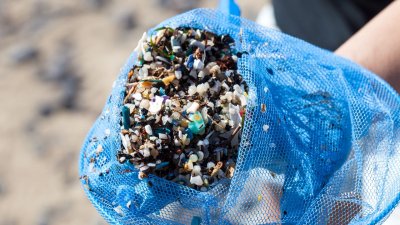
The garbage that the ocean drags to the beaches sometimes has a designation of origin, an ID so clear that not only allows to find out where it came from, but also shows that the Atlantic is a handkerchief, that a plastic that falls into the sea in Newfoundland can surface in Lanzarote in just two years.
The researchers from the universities of the Azores and Las Palmas de Gran Canaria (ULPGC) who document the arrival of plastics to both archipelagos and track their drift through the ocean have long been struck by the number of plastic strips with codes of numbers and letters that they find every year on the coast of La Graciosa, Fuerteventura, Pico or Faial, among other islands.
Finding out what they were was not difficult. A few searches were enough to determine that they were lobster trap tags from fishermen in Quebec, Newfoundland or Nova Scotia (Canada) and Maine, Rhode Island and Massachusetts (United States).
And delving a little deeper revealed that these tags not only identify the fisherman to whom the license belongs, but also specify the specific fishing ground to which they correspond and, in the case of the United States, also the year in which the traps were anchored, as detailed by Marcos Cividanes, Borja Aguiar, May Gómez and Alicia Herrera in the journal "Marine Pollution Bulletin".
For the researchers of the Okeanos team of the University of Azores and the Institute of Research in Sustainable Aquaculture and Marine Ecosystems of the ULPGC, this information is a treasure, since it gives another dimension to the 662 tags of this type that they have collected in the two archipelagos since 1996, sometimes more than 30 per year.
Most of them correspond to the Azores (curiously, their presence in Madeira is almost testimonial), but there are also points in the Canary Islands where they arrive every year: 35 have been collected in the southwest of Fuerteventura, 32 in La Graciosa, 23 in the islet of Alegranza, twelve in Lanzarote... they have only not appeared in El Hierro and La Gomera.
What's interesting about them? Well, so many have been collected, for so long and with so much information (point and date of origin in North America and place and year of arrival in the archipelagos of Macaronesia) that with them, models can be sketched to help better understand the routes that plastic waste follows in its drift through the ocean and, in this way, complete the knowledge of the currents that make up the great gyre of the North Atlantic.
The first conclusion was immediate: a piece of plastic released into the ocean on the east coast of the USA or Canada takes a year or less to reach the Azores and in just two years can appear in the Canary Islands.
Among the 662 plastic strips that make up this study, the 'podium' of transatlantic speed corresponds to a tag from Massachusetts that arrived on the island of Pico in the same year it was anchored (2022), another from Rodhe Island that appeared in Faial after a year (2020-2021) and a third that crossed the ocean from Maine to the beach of Cofete, in Fuerteventura, in two years (2018-2020).
The two universities have also carried out computer simulations with these tags that allow them to see in detail the route they follow and understand that only a very small part of those released each year from the traps reaches the Azores and the Canary Islands.
"Of all the garbage we collect on the coast, it is the only one that is useful to us," jokes Alicia Herrera, from the ULPGC, before pointing out a reflection: "So many are lost in the ocean every year, that someone should have thought about manufacturing them with biodegradable materials, at least" for some time now.
From the original fishing regions they sail southeast with the Labrador Current, until they flow into the great interior 'river' that pushes the waters of the Caribbean towards the Arctic, the Gulf Stream. And, in it, a small part comes into contact with the Azores Current, which transports them further east.
Finally, a small portion is trapped by the Portugal Current, which propels all those plastic remains towards the Canary Current, its highway to the islands and Africa.
The universities that have promoted this study are still pending the trace of these tags to improve the knowledge of ocean dynamics and invite every citizen who finds one on the coast to help them by filling out a simple form on the internet, at https://ofyga.ulpgc.es/es/citizen-science-tags.


Add La Voz de Lanzarote as a preferred Google source.
Stay informed with the latest current news.