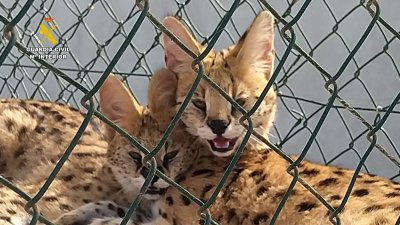
The Civil Guard has seized five African wild felines and investigated three people as alleged perpetrators of a crime against protected wildlife, for the possession and breeding of Leptailurus serval, in the municipality of Las Palmas de Gran Canaria.
The intervention occurred as a result of the "Blood Ties" operation, where the leader of one of the most active drug trafficking networks in Spain was arrested. During one of the inspections carried out on a private estate, agents discovered the presence of several exotic animals on a private property.
The SEPRONA was able to verify that on the property there was an enclosed area of approximately fifty square meters, with a metal mesh and double access door, which housed five specimens of Leptailurus serval: a pregnant adult female, an adult male, and three cubs approximately four months old.
Continuing with the investigations, the agents determined that the animals had been introduced into the Canary Islands without the mandatory CITES authorization or customs or health control
For this reason, the five African serval specimens were seized and three people are being investigated for their possible involvement in a crime against protected wildlife, in addition to possible administrative and customs infractions. The custody of the animals has been assumed by specialized centers for exotic fauna, with the authorization of the Ministry for Ecological Transition and the Demographic Challenge (MITECO). The specimens are currently housed in accredited CITES receiving facilities, as well as specialized in the custody, handling, and welfare of exotic fauna
Possession, breeding, and trade of potentially dangerous wild animals
The introduction of these types of animals constitutes a serious offense, given that Decree 30/2018 of the Canary Islands Government expressly prohibits the possession, breeding, and trade of potentially dangerous wild animals, including all felines of the Felidae family, except for the domestic cat (Felis catus).
Likewise, Law 7/2023 on the protection of animal rights and welfare reinforces this prohibition by not allowing them to be kept as companion animals
Citizen collaboration
Citizen collaboration is essential for detecting and preventing the illegal trafficking and unauthorized possession of protected or prohibited species, one of the main threats to biodiversity and ecological balance
The State Security Forces and Corps remind citizens that the possession, breeding, transport, or trade of wild or exotic animals, as well as species included in the CITES Convention or prohibited species, requires prior authorization and registration with the CITES administrative authority or the competent regional body.
Anyone who owns animals with these characteristics must report it to the competent authorities or security forces and bodies, to verify their legality and, if applicable, proceed with their regularization or voluntary surrender
Voluntary regularization avoids penalties or criminal liability and contributes to protecting biodiversity and public safety, preventing the ownership and reproduction of potentially dangerous or invasive wildlife



Add La Voz de Lanzarote as a preferred Google source.
Stay informed with the latest current news.