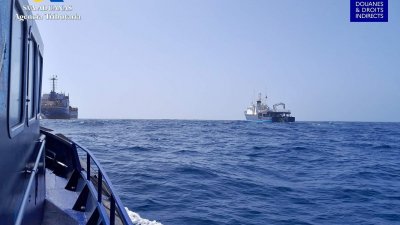
The Customs Surveillance Service of the Tax Agency, within the framework of operation 'Pascal-Lino 2024' carried out jointly with French customs, has intercepted a cargo ship 130 nautical miles from Lanzarote, named 'Ras', 70 meters long and flying the Tanzanian flag, which, according to initial estimates, was carrying 4,000 kilos of cocaine. As a result of the intervention, the ten crew members of the ship have been arrested.
The control of the cargo ship was carried out by the crew of the Special Operations Vessel 'Petrel' of Customs Surveillance together with the patrol boat of the French customs 'DPF-3' during the operation 'Pascal-Lino 2024', a bilateral project by which both customs deploy naval and air assets to intensify surveillance and control in different maritime scenarios each year, and which on this occasion was taking place in waters of the Atlantic Ocean.
In the course of the operation, the ten crew members of the cargo ship have been arrested, five of Turkish nationality, including its captain, two nationals of Azerbaijan and a citizen of Dutch nationality.
The cargo ship was being monitored from the Maritime Analysis and Operations Centre for Narcotics (MAOC-N) based in Lisbon and, at national level, the operation has been coordinated with the National Police and Civil Guard through the Coordination Centre against Terrorism and Organised Crime (CITCO).
A round trip through the Mediterranean and the Atlantic
On this occasion, the researchers' attention was drawn to the fact that the cargo ship carried out an uneconomical voyage, having set sail from Turkey, sailed through the Mediterranean to the Atlantic front, then to Sierra Leone and Guinea Bissau without having loaded or unloaded any merchandise and, after carrying out erratic maneuvers, set course for the Iberian Peninsula.
The presence of the air-naval assets of the Customs Surveillance Service and the French customs in the area made it possible to carry out the operational action on this vessel in an agile manner and prevent the drug from being transshipped to other smaller vessels and reaching the Spanish coasts.
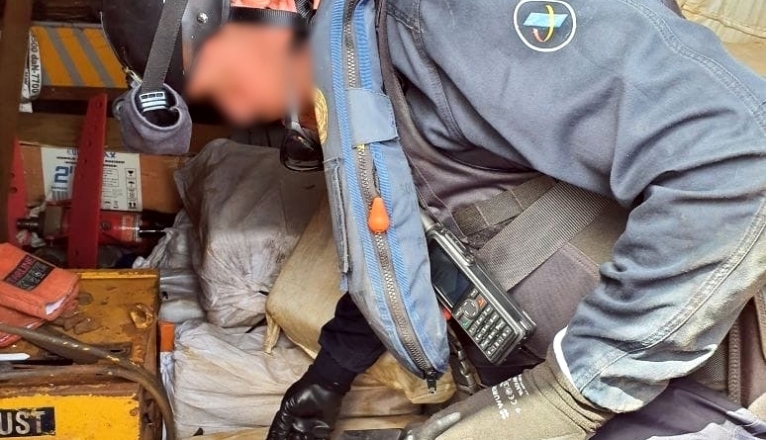
The narcotic substance was in a compartment between the cargo ship's holds with very difficult access and outside the main corridors of the same, which initially made its location difficult.
The operation culminates today with the arrival of the 'Petrel' and the seized cargo ship to the port of Arrecife, in Lanzarote, for the unloading of the drug and making the detainees available to the courts by Customs Surveillance, National Police and Civil Guard.
Operations 'Pascal-Lino' and 'Pascal-Iborra'
These operations are carried out within the framework of air-naval operational cooperation between the customs of Spain and France since 2017, with a wide deployment of resources in areas of maritime interest where to reinforce actions aimed at combating customs fraud by sea in the Mediterranean Sea, Cantabrian Sea and North Atlantic. Resources are deployed for two operational campaigns each year called 'Pascal-Lino' and 'Pascal-Iborra' in homage to a French customs officer and two officials of the Customs Surveillance Service who have already passed away.
The 'Pascal-Lino-Iborra' project is thus a great platform for cooperation between both customs, focused on the maritime field, during which not only are crew members exchanged on board the different oceanic patrol boats and observation and surveillance aircraft, but protocols, knowledge and good practices are exchanged that help both customs to perfect their response against illicit trafficking by sea.
Add La Voz de Lanzarote as a preferred Google source.
Stay informed with the latest current news.