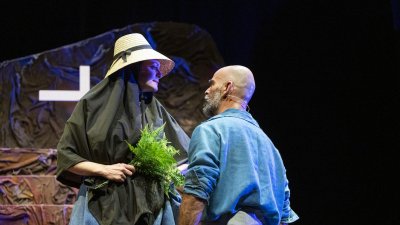
The play Mararía la de Femés, which was inspired by the novel by the Tenerife writer Rafael Arozarena (1923-2009), begins its "intense tour" on September 23 in Fuerteventura. After that, it will continue in Lanzarote, Gran Canaria and La Palma.
After its presentation on September 23 (8:00 p.m.) in a free performance by prior registration until full capacity, at the Raíz del Pueblo Cultural Association of La Oliva (which absorbs part of the cultural program of the Casa de los Coroneles of Fuerteventura currently under construction), Mararía la de Femés can be seen on September 30 at the Víctor Fernández Gopar Theater El salinero of Lanzarote (two performances scheduled at 7:00 p.m. and 10:15 p.m.), and then premiere on November 10 on the stage of the Teatro Circo de Marte of La Palma (8:30 p.m.), and later return to Gran Canaria on November 18, where it can be seen at the Teror Auditorium (8:30 p.m.).
The planned performance in La Palma has the collaboration of the Mares Program promoted by the Canary Islands Institute of Cultural Development of the Government of the Canary Islands, which allows groups and companies to show their shows on islands other than the ones where they reside.
The aforementioned montage is part of the performing arts project Segunda Lectura whose philosophy is based on the revision of masterful texts of theater and universal literature, approaching them from a contemporary and innovative vision in their staging.
The aforementioned theatrical production, directed by Mario Vega from the free version that the professor at the University of Las Palmas de Gran Canaria, Yeray Rodríguez, has made for the occasion, includes in its cast Marta Viera, Mingo Ruano and the singer LAJALADA (Belén Álvarez Doreste), who will perform live the original musical libretto of this montage whose lyrics have been written by Yeray Rodríguez, author of the dramaturgical adaptation that has the approval of Arozarena's widow.
Mario Vega, director of the montage Mararía la de Femés, points out “the challenge of embarking on the scenic adaptation of a novel of the magnitude of 'Mararía', with what it means for the Canary Islands, as well as giving voice to the protagonist of the montage (played by Marta Viera), although in Arozarena's novel she does not utter a word. In our version, she tells her story for the first time in the first person, she tells us about her life in a suffocating society in a small peasant town in the Canary Islands of the 50s, with everything that this meant then.”
As the author of the scenic version, the philologist Yeray Rodríguez, advances, the revisiting of this imperishable classic of Canarian literature that has crossed several generations of Canarians, “proposes us to question part of our own paradigms. Unlike in the novel, in this theatrical proposal Mararía has her own voice and her feminine identity takes on meaning and dimension. Therefore, it gives voice to a Mararía silenced and relegated to oblivion as a passive subject of the drama, because her story does not only tell the story of Mararía la de Femés, but the story of all the Marías, of all those displaced, marginalized and forgotten women.”
Timelessness of the version
The design of the Mararía la de Femes proposal is projected to achieve a timelessness of the version, so there is a decontextualization in the entire aesthetics of the montage, from the costumes to the scenography. In addition, the complex, fluid and rich creativity of the piece is manifested both in the sound space (which provides a combination between diegetic and non-diegetic music), as well as in the multiplicity of languages and audiovisual and theatrical codes used.
In Mararía Rafael Arozarena auscultates the folds of an enigmatic and immutable woman where the restless and bubbling magma of the island of Lanzarote seems to reside, her longings and unfulfilled desires. The scorching landscape that surrounds the small payment of Femés overwhelms the readers who enter this novel, dragging them to a world that, although belonging to reality, encourages them to cross to a certain liminal zone of shadows, echoes and fences. Of porous boundaries between what is and what is not, while the dogs bark at the moon at night. Mararía, the writer once said, is the spirit of Lanzarote.
Capital work of Canarian letters
Rafael Arozarena, author of Mararía and Canary Islands Prize for Literature in 1988, made one of the most interesting contributions to the culture and letters that are woven in the islands in the second half of the 20th century, with a superb production that encompasses both poetry and the novel. Component of the fetasiano group that made a brave revolution in post-war literature, in the midst of the oppressive reality of the dark years of Francoism, he developed a vision on literature, the human being and his difficult relationship with the world, which constitutes a fundamental link in contemporary Canarian culture.
Mararía, which was a finalist for the Nadal Prize in 1971 and was published in 1973 in the middle of the boom of the new Canarian narrative, gives the writer an unexpected fame, the aforementioned title remaining forever linked to his name, although he always admitted that the book that truly justified him as a narrator was Cerveza de grano rojo, which would appear in 1984.
In the forties of the last century and in Femés, where Arozarena when he was in his twenties was employed working for the Telefónica company as a technician in the process of installing the antennas in the Atalaya de las Mujeres, he began to compose this epic and disturbing story that has ended up becoming an iconic work of Canarian letters. 'Mararía' would consolidate his narrative in the context of Spanish literature of the time, although the popularity that the work reached did not divert the author from what was his essence: poetry.
Rafael Arozarena turns Mararía into a myth from the narrative and lyrical inquiry that he raises around the spirit of a woman with lips as thin as knives. Arozarena's visionary ability made Mararía silent so that absolutely everyone would pay attention to her and make her rebellious and combative mutism our own.
It is not the first time that the Pérez Galdós Theater and the production company unahoramenos have jointly promoted a large-scale project. An example of this collaboration is the Laboratorio Galdós scenic experimentation project, which has been operating since 2018 and has so far produced five different scenic montages, the last two carried out within the framework of the Laboratorio Galdós Internacional, pending the next premiere in October of the third of them, 'Protocolo del quebranto'.


Add La Voz de Lanzarote as a preferred Google source.
Stay informed with the latest current news.