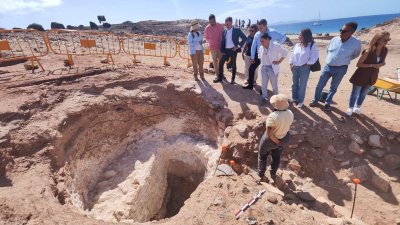
Within the framework of the collaboration agreement between the Government of the Canary Islands, the Yaiza City Council, the University of La Laguna (ULL), and the University of Las Palmas de Gran Canaria (ULPGC), Doctors María del Cristo González and Esther Chávez are carrying out the third phase of archaeological research at the San Marcial de Rubicón site (Yaiza). Among the most outstanding findings of this campaign is a lime kiln, the first excavated on the island of Lanzarote, which represents a significant advance in the study of the development and evolution of the first European city founded in the Atlantic.
For five weeks, work has been carried out in various sectors of the enclave in collaboration with the specialized company Baraka Arqueólogos and the participation of more than a dozen students from both public universities in the Canary Islands. One of the main objectives of the fieldwork has been to continue with the delimitation of the cemetery located in last year's intervention, where a dozen individuals were recovered, to which the skeletal remains of three additional people are now added.
The Minister of Universities, Science, Innovation, and Culture, Migdalia Machín; the General Director of Culture and Cultural Heritage, Miguel Ángel Clavijo; the Mayor of Yaiza, Óscar Noda; and the Councilor for Historical Heritage of the Cabildo de Lanzarote, Ascensión Toledo, visited the enclave to show their support for the research team and reaffirm their commitment to the recovery of the history of the Canary Islands.
In that sense, Migdalia Machín stated that "Canarian heritage is the pillar that sustains our Atlantic identity, and through its study and conservation, we reaffirm the universal character of our culture. By investigating and preserving our past, we are bringing to life the episodes that shaped us, transforming oblivion into remembrance, and reviving a memory that enriches the present and strengthens our Canarian identity.
This project, supported by the collaboration of the public universities of the Canary Islands, not only revitalizes our roots but also empowers the new generations of archaeology professionals, providing them with the practical experience necessary to continue this important work. In this way, we ensure that the study and protection of our heritage remain in the hands of those who will safeguard our history, projecting it into the future."
For his part, Miguel Ángel Clavijo reiterated that "the advances in San Marcial de Rubicón not only deepen our knowledge of the past but also consolidate our commitment to research and the protection of heritage. After the fieldwork, the materials found will be studied in depth in the Laboratory of Archaeology and Prehistory of the University of La Laguna, which will allow us to obtain a detailed and scientific analysis of each finding."
Óscar Noda wanted to highlight "the commitment of the research team led by archaeologists María del Cristo González (University of Las Palmas de Gran Canaria) and Esther Chávez (University of La Laguna), which continues the exploration in this historical enclave. Our proposal is to condition the site to create an archaeological park that can be visited in a controlled manner. We are committed to the research and dissemination of our heritage values, so here we continue to add resources together with the Autonomous Community and the two public universities of the Canary Islands."
Lime kiln
According to González, "the most spectacular finding of this year" is the lime kiln because "it is the first time that an archaeological excavation has been carried out on an element of this type in Lanzarote," she justified. It is a lime kiln partially excavated in the rock of approximately three meters in diameter and "inside it, a lot of burnt stone and lime is preserved, so we are excavating the last load of this kiln," she explained.
However, the walls that have been excavated so far contain lime, as do some occupation floors, which could indicate that this kiln "could be associated with the life of the city and even that it was used to build this settlement from its beginnings," the archaeologist advanced. However, until the dating of the lime is carried out, this is only a hypothesis that contributes to the development of the investigation.
It should be remembered that San Marcial de Rubicón, located in the municipality of Yaiza on the island of Lanzarote, is an archaeological enclave of a high scientific and heritage level, since from here the process of exploration and conquest of the Canary archipelago began in the 15th century. This undertaking involved the construction of architectural elements that have been discovered in recent years, such as a tower-fortress, a church, some wells, as indicated by the chronicle 'Le Canarien'; as well as other structures and spaces related to the settlement and coexistence between the two populations.
These new findings are possible thanks to the collaboration agreement between the Government of the Canary Islands, the Yaiza City Council, the ULPGC, and the ULL, which has recently been extended from two to four years (2024 - 2026) to ensure the continuity of this archaeological project, which is fundamental to reconstructing the history of the archipelago.


Add La Voz de Lanzarote as a preferred Google source.
Stay informed with the latest current news.