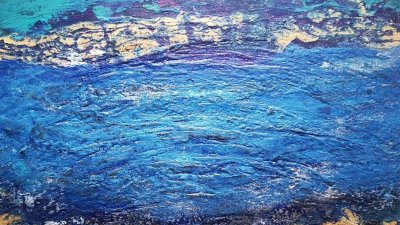
The exhibition hall of the San Antonio hermitage, Tías, hosts this Thursday at 7:00 p.m. the inauguration of Blue Island, the first painting exhibition by the Lanzarote artist Nadima García after dedicating herself to photography for decades. They are paintings of marine images, dreamlike backgrounds and endless aquatic perspectives.
The Councilor for Culture, Pepa González, points out that the exhibition will remain open until April 12, so she invites citizens to “enter these canvases as a dive into the sea. His work makes us travel to childhood, especially among those people who since childhood have been in contact with the coast of Lanzarote.”
The paintings go beyond the image of the sea as a natural element, since Nadima García immerses the public in emotions, memories and sensations, many of them impregnated by the insularity itself. It is a whole amalgam of textures and colors, ranging from cerulean to jet, passing through ochres, turquoises and indigos, a pictorial camouflage that impresses and confuses in equal parts.
The artist explains that Blue Island “is contrast, it is movement and, especially, it is a superposition of layers and textures – some of them almost imperceptible to the human eye – as if they were marine sediments. The exhibition is an ode to nature and highlights the beauty of the environment that surrounds us and that we are destroying.
Nadima García studied photography at the Pancho Lasso School of Art and later moved to Madrid to continue her studies. Upon her return to Lanzarote, she carried out various tasks, such as advertising, press and teaching, teaching analog photography workshops for the Cabildo de Lanzarote for several years.
She actively participated in the island's artistic scene in exhibitions such as The Figured Space, Borders, 21st Century: a new ethic and Biennial off Fotoars 2001; as well as in Fotonoviembre 2005, organized by TEA Tenerife Espacio de las Artes. It is worth mentioning the collective exhibition Another Vision of the Sky, organized by the Government of the Canary Islands, which after touring the Islands was taken to the Cervantes Institutes of Brussels, Lyon, Lisbon and the Centro Espacio Canarias in Madrid.


Add La Voz de Lanzarote as a preferred Google source.
Stay informed with the latest current news.