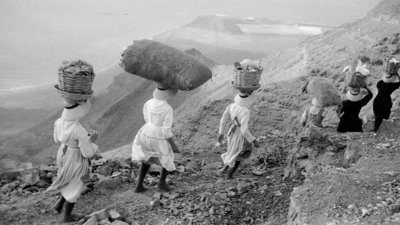
Javier Reyes, a photographer from Lanzarote who recently passed away, was the creator of one of the most important documentary collections on the island. For almost 30 years he captured the daily life of the inhabitants of northern Lanzarote and the islets of the Chinijo archipelago. La mirada artesana, a documentary produced by the Data Center of the Cabildo of Lanzarote and made by Veintinueve Trece, pays tribute to the figure of the artist and reviews his immeasurable legacy. Filmoteca Canaria will screen it next Thursday, September 19 at the Espacio La Granja in Tenerife starting at 7:00 p.m., with free admission until full capacity is reached.
After the screening there will be a debate with the participation of Nico Melián, director of the documentary, head of the Veintinueve Trece studio and professional photographer, Mario Ferrer Peñate, screenwriter and author of the original idea of the work, as well as journalist and author of the book 'Photography in Lanzarote 1850-1950' and Miguel Ángel Martín Rosa, director of the Data Center of the Cabildo of Lanzarote. During the talk, they will delve into the legacy, the work methodology and the importance of the work of the photographer from Lanzarote.
With more than 16,000 negatives, Javier Reyes generated one of the most remarkable legacies of the visual, cultural, historical and anthropological heritage of Lanzarote and La Graciosa. He developed this work tirelessly between 1943 and 1972, giving rise to a project that shows the change and evolution of the Canarian society of the time. Based in his studio in Haría, his hometown, he showed enormous skill in reflecting with truthfulness, humanity and closeness the customs and experiences of his neighbors.
La mirada artesana seeks, therefore, to pay tribute to and disseminate the commendable work of the photographer while delving into his techniques and work system through statements by the artist himself and his relatives. His collection is so diverse and profuse that it has attracted the attention of historians and researchers from all over the world to the point that his work has been exhibited in several parts of the Canary Islands and other islands of Macaronesia. In 2013, the Cabildo of Lanzarote began the process of digitizing and disseminating its archive, which can be viewed completely and free of charge in the Digital Memory of Lanzarote.



Add La Voz de Lanzarote as a preferred Google source.
Stay informed with the latest current news.