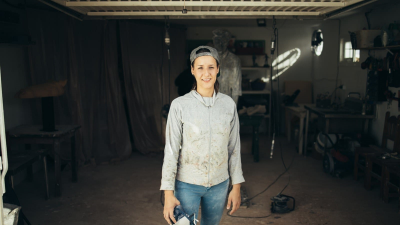
It can be said that Cintia Machín is an artist who has a little piece of her in almost every corner of Lanzarote. Born and raised in the Salinas del Janubio in 1995, her love for art began to take shape when she was studying and realized that her thing was creativity.
Machín is a pioneer in her family in dedicating herself to art because the only reference she has had is César Manrique. "My curiosity for art begins when I realize that in my studies I am totally terrible but I was good in the artistic part because the best way I communicate and express myself is through images," she says.
"I drew the language notes and that's how I remembered in the exams what I had to answer, and in this way, little by little, I was developing that way of communication through images where I understood that my mind worked through the visual and expressed itself and retained information through that form," she says.
Thanks to the support and encouragement given to her by a teacher at the institute where she studied to enroll in the Pancho Lasso Art School and do the Arts Baccalaureate, the sculptor decided to listen to him and dedicate herself to what she liked the most. "That's where my artistic side begins where I demonstrate to others and to myself that the gift I was born with was to express myself through art," she declares.
In addition, different teachers aroused her curiosity for the sculptural branch, for the three-dimensionality that, for the artist, "brings together the three basic pillars of Fine Arts, which are drawing, volume and painting".
The process to create a sculpture
The sculptures made by the artist are usually intended for tributes and memories, that is, for the people themselves. These proposals come from public or private administrations, depending on the case. "My mission is to give an image to that memory or tribute that is wanted to be made, and through my skill with my hands and my understanding of art I give life to that person or memory," she explains.
After the bureaucratic process of the administrations that includes the budget, a proposal, several sketches and a dialogue with the competent entity, the idea of how the proposal should be is established. "From there begins the 'laboratory' part, as I say, where I get into the workshop," she indicates.
Once in the workplace, Machín unleashes her talent and creates, from scratch, the sculptures that we can see in different municipalities of Lanzarote. "It starts with an iron frame, a skeleton, which will be the work to support the clay, a clay that I model in such a way that I reach the figure I want to represent," she reveals.
"When I already have the frame and the clay in place, I create the sculpture and give it the shape I want, I make a negative plaster cast," Machín explains. The artist defines it as if she were making "the mold of a cupcake". After this step, the process continues by filling that mold, whose material depends on the budget. "If there is enough it can be bathed in bronze and if the budget is lower then I do it in the workshop with polyester resin, the same material with which boats are made," she clarifies.
The creation time takes months for Cintia Machín, since the process must be careful and, in addition, they are sculptures, in general, of great size. "I usually take two months or two and a half months," she says. However, this depends on the type of sculpture. "In terms of time, it was a challenge to make the sculptural ensemble of San Bartolomé in tribute to the sweet potato, in which I took eight months," she recalls.
One of the most beautiful things that this profession has given the artist are the anecdotes with the people to whom her sculptures pay tribute. One of those anecdotes occurred with the bust in tribute to José María Espino, who was a teacher in Mácher and mayor of Arrecife. "His students wanted to pay him tribute and there we involved the family, and it turns out that one of his sons was my English teacher and in the inauguration speech he emphasized the circle of me having created a sculpture of his father and of him having taught me," she says.
"We both started crying in the middle of the inauguration and having met José María Espino through the family and that he gave me the gift of the human part of getting involved has made it one of the most emotional sculptures I have made and that, in addition, has a therapeutic sense for the family," reflects the artist.
A talent distributed throughout the island
Cintia Machín's sculptures can be found in almost every corner of Lanzarote. One of those sculptures is the one found in Femés in tribute to Mararía by the Canarian writer Rafael Arozarena. Also the work that remembers and highlights the fishermen and sailors in one of the roundabouts of Playa Blanca or the recognition of the salt workers of Janubio.
Also, the tribute to the victims and resilient of gender violence that is located in Playa Honda, among many other works that have made the talent of the sculptor not only present in Lanzarote, but also in other islands such as La Gomera.
Her way of working and her skill with her hands has made the administrations trust Cintia Machín to give life to people and memories that deserve to be recognized so that the people never forget their history or their roots.

Add La Voz de Lanzarote as a preferred Google source.
Stay informed with the latest current news.