
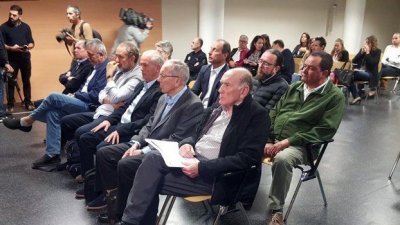

Photos: Sergio Betancort
The main trial of the Stratvs case has started this Tuesday with ten people in the dock and with a request from the Prosecutor's Office for 15 years in prison for the owner of the winery, Juan Francisco Rosa. For its part, the popular accusation exercised by Urban Transparency raises the request for Rosa to about 20 years in prison, in a trial that is expected to last 25 days, the first in Lanzarote and then in Las Palmas de Gran Canaria, where the last sessions are scheduled for early April. The Prosecutor's Office requests the second highest penalty, of 10 years in prison, for the architect of Stratvs and owner of a part of the land, Miguel Ángel Armas Matallana.
In total, there were 17 people accused in the case, although several were already tried and convicted in the piece that was separated due to the parliamentary immunity of Gladys Acuña, who was then a regional parliamentarian. However, some are also in this second hearing, since in the first only the facts related to the granting of the activity license to the winery were judged, which was what Acuña intervened in.
Along with Rosa, in this second trial, the former Councilor for Urban Planning, José Antonio Rodríguez, and the former mayor, José Francisco Reyes, who is currently in prison and has attended the trial handcuffed and guarded by the Police, are also accused. To them are now added in the dock the surveyor of the Technical Office of Yaiza, Pablo Carrasco, the technician Andrés Morales and the person in charge of the Cadastre of Yaiza, Blas Noda.
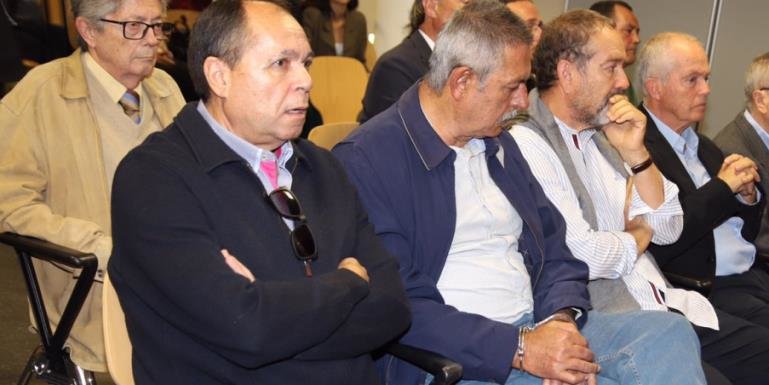
Image of the former mayor of Yaiza, José Francisco Reyes handcuffed during the Stratus trial
In addition, the former manager of the Insular Water Council, José Juan Hernández Duchemín, and three other people who have held technical or political positions in the Government of the Canary Islands are also being tried: Faustino García Márquez, Armando Villavencio and Juan César Muñoz Sosa. For these last three, the Prosecutor's Office requests fines and disqualification penalties. The ten defendants, to which the company BTL is added as a legal entity, are scheduled to testify between this Tuesday and next Thursday, January 16, once the preliminary issues with which the trial has begun are resolved.
"They did not put any obstacles to their urban and speculative excesses"
In its indictment, which was presented almost five years ago, the Prosecutor's Office points out that the public administrations that should have ensured compliance with urban and environmental legality "did not put any obstacles to the urban and speculative excesses of the businessman, nor to his desire for profit, at the cost of seriously attacking the island's environment to the detriment of all the people of Lanzarote".
As highlighted by the investigation of this case, Juan Francisco Rosa requested a license to restore a protected house and to build a 900-meter warehouse-winery and what he did was demolish the house and build a new, larger one, building around it a macro-complex of 12,000 square meters on protected land. Thus, in addition to a large winery, he also built a store, a restaurant, kitchens, walls and different terraces that had no legal coverage and where he held all kinds of events despite lacking a license and with the passivity of the administrations, until the judge who investigated this case, Silvia Muñoz, ordered the sealing.
In addition, the Prosecutor's Office maintains that even the first license he obtained, and which had nothing to do with what he ended up building, was also illegal, to which is added that the land where he built Stratvs was not even his. In fact, it was before the proximity of the trial when Rosa bought the land from the families that were present in the case as injured parties, thus managing to withdraw from the procedure and stop exercising the private prosecution.
"A continuous and premeditated fiction"
In the order that put an end to the investigation of this case, the investigating judge pointed out that the construction of Stratvs was based on a "continuous and premeditated fiction", which began from the request for the first permit. For this, they used that pre-existing protected house, which did not even belong to Rosa, but which was key to requesting that first authorization. That is where the architect, Miguel Ángel Armas Matallana, came on the scene, who had part of the ownership of that land through his family, although they were not the only owners (other owners were those who had appeared as accusation in this case).
Even, in the first license application, the name of Rosa does not even appear, but that of the architect's wife, who was the one who requested the first permit. Later, that request was "mutating" - since initially only the rehabilitation of the pre-existing house was proposed and later it was extended to "restoration of housing and warehouse", even simulating that there was also an old winery - and by doing so, the signature of the applicant was "falsified", according to what her own husband acknowledged in the Courts.
However, despite not appearing the name of Rosa, the Government of the Canary Islands sent him the notifications about this file. Later, once the permit was obtained, what was built had nothing to do even with the project that had been authorized, and that would also be illegal according to the Prosecutor's Office. And to all this were added other "false data", including cadastral alterations and a delay of four years in the term that had been set to finish the work, without the City Council acting despite having opened a file.
In addition, both the Court and the Prosecutor's Office concluded that "one of the most clearly differentiated elements of this protected space was irreversibly altered, such as the Barranco del Obispo, and at least 44,000 cubic meters were excavated, with the consequent extraction of stone, earth and rofe, the latter being a non-renewable resource and which is part of the elements to be protected in La Geria".
"Serious risk" due to polluting discharges
The indictment signed in its day by Ignacio Stampa, who currently works in the Anti-Corruption Prosecutor's Office in Madrid, also included other crimes allegedly committed after the opening of the winery, since there were reports from 2006 until December 2008 warning that the facilities "did not comply with the regulations regarding the evacuation of wastewater". However, the Insular Water Council dependent on the Cabildo came to grant permits for the discharge system, despite the fact that there were reports warning of contamination.
In fact, the Prosecutor's Office points out that a "serious risk" was caused to the balance of the Protected Space and even to the health of people, in view of the contamination parameters shown by the discharges from the facilities, highlighting that said contamination was only stopped by the Court of Instruction, by cautiously closing the complex in the face of the permissiveness of the competent municipal and island authorities.
In its indictment, in addition to prison sentences and significant financial fines, the Prosecutor's Office also demands the demolition of the Stratvs macro-complex, the definitive closure of the activity and the nullity of all the licenses and permits that were granted, as well as the public deeds and registry entries made in relation to the Stratvs complex.
Eight convicted in the first trial
Regarding the first trial that has already been held, eight of the ten people who sat in the dock were convicted of malfeasance. One of them was the mayor of Yaiza, Gladys Acuña, who was forced to leave politics after being imposed 14 years of disqualification and the payment of a fine of 10,800 euros, in a sentence that is already final.
The councilors who were part of the Governing Board when the activity license of Stratvs was authorized were also convicted of malfeasance: Leonardo Rodríguez, Juan Lorenzo Tavío and Evaristo García, as well as the former mayor, José Francisco Reyes, with whom that file began, and the former councilor José Antonio Rodríguez, who first governed with Reyes and then with Gladys Acuña. Like the former mayor, José Antonio Rodríguez was convicted of omission, for not having adopted measures against the winery and the rest of the facilities of the Stratvs macro-complex despite being aware of its illegality.
The other two convicted in that piece were the technician of Yaiza Andrés Morales and the former municipal secretary, Vicente Bartolomé Fuentes, while the technician of the Cabildo Manuel Jesús Spínola Perdomo and Juan Francisco Rosa himself were acquitted, who in that first piece that was judged was only accused of a crime of influence peddling.
In this regard, the sentence pointed out that the telephone calls that had been intercepted by the UCO, in which Rosa called the Councilor for Urban Planning claiming that license, "do not reveal a pressure of sufficient entity" to convict him of that crime. For that reason, only the politicians and technicians who intervened to grant him that permit were convicted. Now, however, the businessman faces charges for more than a dozen crimes of which he would be the direct perpetrator, including crimes against the environment, against land planning, against historical heritage, of fraud, of document forgery and of usurpation, which are the main ones that were investigated in this case.


Add La Voz de Lanzarote as a preferred Google source.
Stay informed with the latest current news.