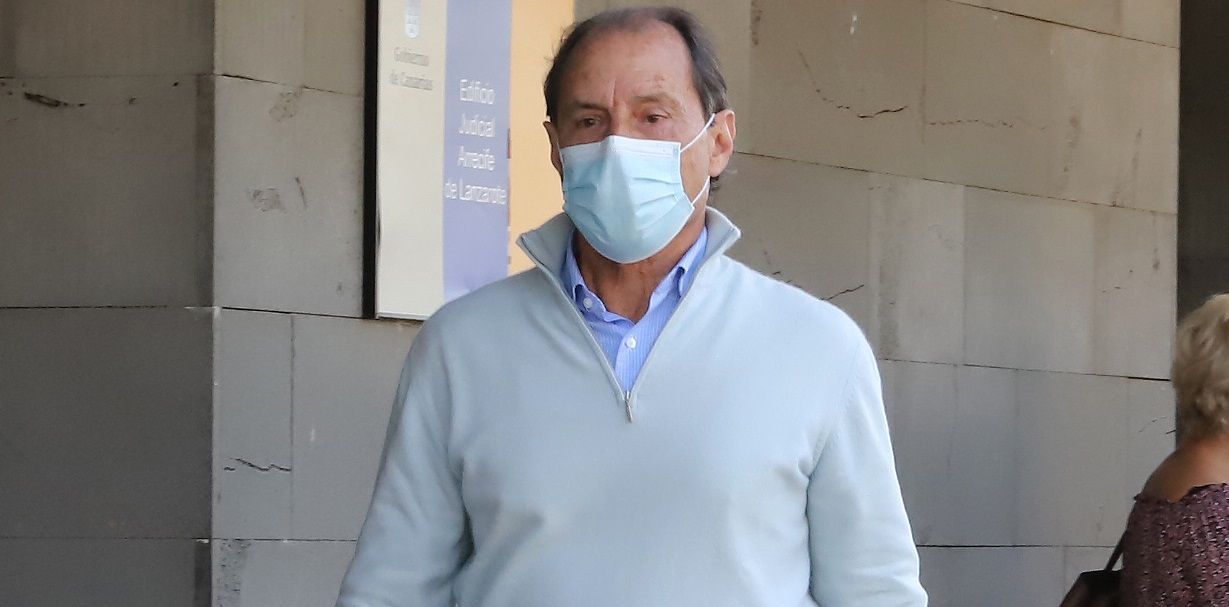
The case that will once again put Juan Francisco Rosa in the dock has once again been supported by another section of the Provincial Court of Las Palmas, which even praises the “excellent motivation” in all the orders issued by the investigating judge, Jerónimo Alonso. This time it has been the Sixth Section, the same one that acquitted Rosa in the Stratvs case, which has confirmed that there are indications of criminality, thus rejecting the appeal presented by the businessman against the order that put an end to the investigation and opened the process to take it to trial.
This resolution, which also imposes the payment of costs, is added to the one issued a few days ago by the First Section of the Court, which also rejected the appeals of two other defendants in the case, Anselmo Rosa and Rosa María Rosa. Along with them, two sons of Juan Francisco Rosa are also being prosecuted, and the five must answer for alleged corporate crimes, misappropriation and document forgery in the management of Hotel Los Fariones SA, to the detriment of its partner, García Bravo e Hijos SL, who was the one who reported the events and exercises the private prosecution.
In its order, the Sixth Section of the Court reviews not only the various investigated and allegedly criminal operations, but also the statement made by Juan Francisco Rosa in the Courts during the investigation.
The Meetings, "with 4 whiskeys and 5 gin tonics”
Faced with the complaint raised by the businessman in his appeal, alleging that facts that were not included in the initial complaint and for which he was not asked in his statement during the investigation have been included, the Chamber responds by emphasizing that in that statement, Rosa refused to answer the questions of “the only accusation that appeared in his interrogation”.
“There also seem to be indications of the possible falsity of the minutes of the Meetings, again referring to the statement of the defendant Mr. Rosa Marrero, who stated that these Meetings were held by Honorio (father) and him, at the bar of the Hotel Fariones, not remembering whether or not there was a call”, the order states. “The Meetings were at the Hotel Fariones and Honorio ended up with 4 whiskeys and I with 5 gin tonics”, added Juan Francisco Rosa in that statement.
According to his testimony, which the Court reproduces in its order, “then they met and all the minutes were signed, one or two a year”. Rosa added that they were signed by “everyone”, including himself, his cousins, “Honorio father” - since he stated that “he has only started meeting with the son since 2013 or 2014” - and “little else”. However, the García Bravo family precisely denounces that it was not called to the Meetings and that those minutes were falsified. For its part, the Sixth Section refers to what the Capital Companies Law establishes on “the way of approving the minutes”, which is far from the story told by the businessman.
“Suspicious” capital increases
To this, the Court adds that it also sees indications of criminality in the capital increases made “to dilute the participation of “García Bravo” in Hotel Los Fariones. In this regard, it recalls that Garcia Bravo e Hijos SL held a 25% stake, which is precisely the limit established by law to have the right to access all information, without it being denied.
Again, at this point the order refers back to Rosa's statement, who in response to his lawyer stated that this extension was made “because money was needed”, and not to reduce the participation of his partner. “Let us remember that the order describes as suspicious two extensions for amounts of 1,663,860 pesetas (9,999.64 euros) and 600.01 euros”, since “these amounts would not seem to alleviate (for being certainly small) the lack of money”, points out the Sixth Section of the Court.
The order reviews the various investigated operations, including loans to other companies of Rosa - which were not documented or returned - as well as the use of the hotel as collateral and guarantee for credits that had nothing to do with the company, while Los Fariones accumulated a millionaire debt in unpaid taxes and tributes to the Tax Agency, Social Security and the Tías City Council itself.
In one of the cases, it emphasizes that a “unilateral” mortgage was constituted to guarantee a personal debt that Juan Francisco Rosa in turn maintained with the Tax Agency, for a value of more than 462,000 euros. The minutes of the “alleged meeting” held to approve it were signed as president by Juan Francisco's daughter, Raquel Rosa Caraballo, “when she did not hold said position until December 22, 2014”.
Like that one, the prosecution maintains that dozens of meetings were simulated, to which the minority partner was never summoned. What he believes is that they were faked later to cover decisions that had been adopted against the interests of the company, and that should have been approved in that body.
The order also refers to the “fraudulent sale by the administrators of Hotel Los Fariones of the shares it owned in Lanzasuisa S.A. for 4,302,000 euros, lower than its market value”, also emphasizing that this money “was used in part to settle debts of Juan Francisco Rosa”.
“Unreconcilable” requests from Rosa's lawyer
In his appeal, Juan Francisco Rosa's lawyer, José Antonio Choclán Montalvo, requested on the one hand the dismissal of the proceedings, while at the same time alleging that the investigation “was not exhausted”.
Regarding the request for dismissal, the Court responds that “it seems hardly reconcilable with the 'denunciation' of lack of diligence”. Furthermore, it concludes that once the case has been analyzed, “it seems evident that the dismissal cannot be agreed in any way”.
Regarding new proceedings that would continue to lengthen the procedure, Rosa requested, among other things, that the expert reports from the party that he himself provided be “ratified” in court, and that they be made “available to the judicial expert”. “We do not understand what interest it is for the investigation that the judicial expert knows the existence of other valuations different from his own”, the Court responds.
“What does not seem logical is that, after almost four years of investigation, the clarification and expansion of an expert report is pertinent and useful for the purposes of the investigation, which can also be done in the trial”, adds the order, which describes this request as “disproportionate”. Furthermore, it adds that once the case and the “indications of criminality” have been analyzed, the result of the requested diligence “would not change the decision” of the judge to terminate the investigation and initiate the process to take it to trial.


Add La Voz de Lanzarote as a preferred Google source.
Stay informed with the latest current news.