
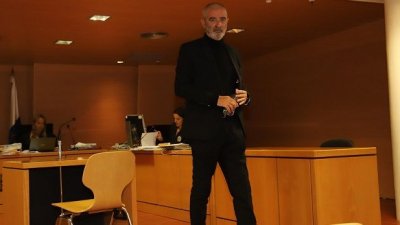
"The criminal route is the last route that citizens have for Justice to bring order." This is how one of the complainants in the Stratvs case, Luis Guirao, explained why a group of people who at that time were forming the Urban Transparency association decided in 2009 to file a complaint to investigate what was happening with the construction of that macro-complex, in a protected area where other winemakers and farmers "were denied any intervention."
"The facts demonstrate that Juan Francisco Rosa's influence was total," he stated when testifying as a witness in the trial, recalling that the Yaiza City Council, the Lanzarote Council and the Government of the Canary Islands allowed these illegal works to continue, and even prominent officials from the three administrations later attended the inauguration.
"Rosa bragged in the media about his Coalición Canaria membership card and that he had a very close relationship," Guirao recalled. In addition, both he and three other complainants have explained that they decided to go to the criminal route because they did not trust the results that the administrative route could give, precisely because of Rosa's "influence."
"One of the most painful things", the inauguration party
"One of the most tremendously painful things, perhaps the most painful, is how that winery was inaugurated. Knowing that it was illegal, that presidents, councilors, councilors were there... it's terrible," Ginés Díaz lamented for his part. This is how he responded to the lawyer of the three members of the Government of the Canary Islands accused in the case - who in turn is the head of the legal services of the regional Executive - and who has focused on trying to question the actions of the complainants, asking them all why they went to the police and did not go to the administration to appeal the permit that had been granted.
"Because legally you can file a complaint at the police station, right?" another of them, Ezequiel Navío, replied, evidencing the legitimacy of the step they took at the time, which gave rise to this criminal case in which the Prosecutor's Office is asking for 15 years in prison for Juan Francisco Rosa, in addition to convictions for members of the Government of the Canary Islands, the Lanzarote Council and the Yaiza City Council. In addition, as one of the complainants recalled, the first piece to be judged also left the convictions for prevarication of the former mayor of Yaiza, Gladys Acuña, the former mayor José Francisco Reyes and several councilors who intervened in the granting of the activity license.
"There are people who always pay for their actions with convictions and he always goes free. That, from my point of view, is influence," Luis Guirao added in response to Rosa's lawyer, who had tried to refute him by recalling that in that first sentence of the case the businessman was acquitted of the crime of influence peddling. Now, when Rosa faces the main piece of the case and accusations for almost a dozen crimes, the complainants have expressed their confidence that this trial will put an end to "impunity."
"There was a demolition sentence for the Fariones and it was not executed"
"The criminal route seemed more effective to us," replied the fourth complainant who testified this Tuesday, Mario Alberto Perdomo, when the lawyer for the technicians of the Government of the Canary Islands asked him the same question, questioning the path they took to ensure that the law was complied with. "My experience in the administrative route is not very satisfactory," the witness began explaining, adding that in the contentious courts "neither" is it. Luis Guirao also referred to this, recalling the sentence that declared the Fariones hotel illegal. "There was a demolition sentence and it was never executed," he lamented.
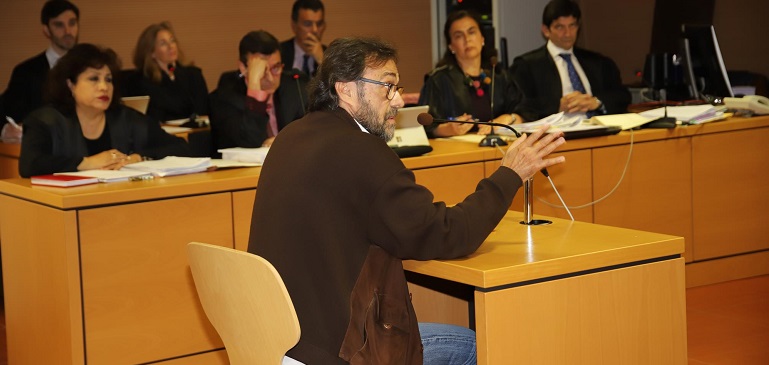
In addition, he again insisted on the public officials who attended the inauguration of Stratvs, when the "macro tourist complex" that was built had nothing to do with what had been authorized - which was the rehabilitation of a house and the construction of a small underground winery of 900 meters - and also to the wedding of Juan Francisco Rosa's daughter, which was even attended by the then Minister of Territorial Policy of the Government of the Canary Islands, Domingo Berriel. In this regard, he recalled that only two days before the Justice had ordered the closure of Stratvs, and Berriel not only attended the wedding but also made statements to the media defending the facilities and advocating for their opening.
The role of Rosa's media group
In his statement as a witness, Luis Guirao also spoke about the consequences that filing this complaint has had for him. "What I have received are insults from Juan Francisco Rosa's media, threats and an attempted purchase," he stated, even assuring that this "attempted purchase" occurred "in writing." Regarding the "insults" and "veiled threats," he pointed to Lancelot Medios. In addition, he has stressed that this communication group of Juan Francisco Rosa "receives funding from the Government of the Canary Islands" and has referred to the contract he signed with Televisión Canaria when it was managed by CC.
The statement of the four complainants has also reflected the difficulty that it can be to file a complaint of these characteristics "on a small island" where "everyone knows each other." In fact, when asked at the beginning of the interrogation if they knew the people who have ended up accused, one stated that "a childhood friend" was sitting on the bench, while another referred to the father of a classmate of his daughter and a third to a friend of his sister.
In this regard, Ginés Díaz also spoke about the fact that Faustino García Márquez has ended up being tried in this case. "I know him from references, and good references," he specified. "What has happened in this case has been tremendously painful," he pointed out. Shortly before, he had also referred indirectly to this technician, when questioning the statement he made as an accused: "A gentleman said in this trial that he had signed a document out of exhaustion," Ginés Díaz underlined when criticizing the role played by the administrations, and in this case the Government of the Canary Islands.
La Geria, without electricity until Stratvs was built
Almost all the complainants have also agreed in stating that the area where Stratvs was built was protected land where it was not possible to build; that electricity did not even reach the area and that it was electrified precisely after the opening of this winery; that there was a fountain and a cistern in the place, so the polluting spills could have affected the groundwater; and that it is not true that the pre-existing house was in ruins, which was supposedly going to be rehabilitated and which, according to the accusation, ended up being demolished to build a new one.
Only Mario Alberto Perdomo, who has explained that he left Urban Transparency years ago, has responded with "I don't know" or "I don't remember" to most of these questions, including whether there was a ravine in that area, known precisely as the Barranco del Obispo.
For his part, Ezquiel Navío - who has explained that he also left Urban Transparency when he started working for public administrations, because the statutes of the association established that it was incompatible - did emphasize that the area was "an old channel of La Geria." In addition, he explained that he decided to sign this complaint before "the resounding failure of the administration's mechanisms to ensure compliance with the regulations" and even spoke of "connivance" with Rosa, recalling that "for years, farmers and winemakers could not move a stone" in La Geria.
The defenses, trying to sow doubts
During the statement of these four complainants - to which the statement of the president of Urban Transparency, Javier Díaz Reixa, must still be added - the defenses have focused on questioning the way in which they filed the complaint; why they did it at that time and not before; and even why they did not initially denounce all the crimes that are now being judged (despite the fact that they were uncovered precisely thanks to the instruction of this case that began with their complaint). But above all, they have insisted on insinuating that the complainants did not do the same with other illegal constructions in La Geria and on trying to compare the situation of Stratvs with that of other wineries.
In this regard, the complainants have stressed that the rest of the wineries in La Geria are old and existed before the current regulations came into force, so "they have the right to be there" and cannot be compared with a new winery, and even less so of the dimensions of Stratvs. In addition, all have referred to other complaints that they have filed from the different groups in which they have been participating for years, in defense of the environment and legality.
In the case of Ezequiel Navío, he has referred to his time as a delegate of Adena, recalling that from the NGO they also filed two complaints in La Geria, in this case against illegal homes. And one of them was precisely demolished recently by the Government of the Canary Islands, after "a long process of 14 years."
For his part, Juan Francisco Rosa's lawyer has focused on asking all the complainants how they obtained the file of the Government of the Canary Islands on the Stratvs winery, trying to sow doubts about how they obtained it. In this regard, the witnesses have responded that it was requested by the current president of Urban Transparency, Javier Díaz Reixa.
"Do you know that there is a certificate from the General Directorate of Territorial Policy that says that the request is not recorded?" he asked one of the complainants. "For us, that is another evidence of Rosa's influence on the Government of the Canary Islands," Luis Guirao replied, insisting on what they consider to have been a history of "impunity and connivance."


Add La Voz de Lanzarote as a preferred Google source.
Stay informed with the latest current news.