
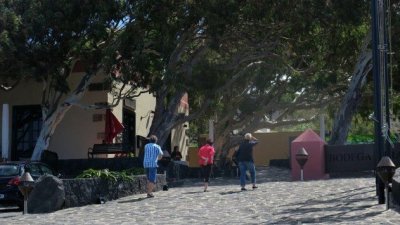
The Yaiza City Council has ordered the closure of the Stratvs winery, which was sealed more than five years ago by court order and which reopened its doors about two months ago without having obtained a new license. What the owner of the winery, Juan Francisco Rosa, did at that time was to take advantage of the new regulations that allow a business to open with a responsible declaration while permits are granted. However, once again, that declaration that he submitted did not conform to reality.
"It does not comply with the documentation they presented," explained the mayor, Óscar Noda, this Monday, who for weeks had been pointing out that the Council was awaiting reports to make a decision. Now, after visiting the facilities and analyzing the documents provided by the businessman, those reports are already on the table and led to the notification of the closure order last week.
However, the mayor specifies that the company is still "within the period for allegations" against that decision, so for the moment the Council will not act to guarantee that this closure is complied with. "Once they present them, we will continue to study and review it," added Noda.
Some Cabildo conferences included a visit to this illegal winery
At the beginning of last March, La Voz de Lanzarote already reported that the Stratvs store had reopened without a license, but later it became known that Rosa had also restarted the winery. In fact, some conferences of gastronomic journalists organized a few weeks ago by the Cabildo -and which were held in other illegal facilities of the same businessman, the Princesa Yaiza hotel- even included a visit to this illegal winery, which hosted part of the activities financed with public money.
The Stratvs complex was closed by court order more than five years ago and although that precautionary measure was lifted four years later in an order issued by the controversial judge Salvador Alba -currently suspended and awaiting trial for serious crimes of corruption in the exercise of his office-, the Chamber later warned that this did not imply "the authorization of this Court for the exercise of the activity." In that subsequent resolution, the Court made it clear that what it did was lift the precautionary measure due to the time elapsed since it was adopted, but without analyzing whether its reopening was legal or not. Thus, it left the decision in the hands of the institutions, pointing out that it should be the Cabildo and the Yaiza City Council who ensure compliance with the "regulations."
For its part, the Prosecutor's Office strongly opposed the reopening of Stratvs, stating that "its operation is illegal due to the lack of enabling titles and the frontal contradiction with the urban planning that applies to it." In fact, in the first trial of the Stratvs case the activity license that allowed its opening was already declared illegal, under the Mayoralty of Gladys Acuña, and both she and seven other people were convicted for having granted that permit.
The Prosecutor's Office requests demolition
In the main trial that is still pending trial, the Public Prosecutor's Office demands the demolition of the entire complex, arguing that it is illegal and cannot be legalized. And it is that in addition to pointing out that he obtained an illegal permit, the investigation of this case revealed that what was built did not even have anything to do with what had been authorized, which was the rehabilitation of a protected historic house and the construction of a 900-meter winery. Instead, as the prosecution maintains, Rosa demolished that protected house and built a new one - which is where the store is located - and built a complex of more than 12,000 square meters, which also included terraces and a restaurant that were not even included in the project.
During the investigation of the Stratvs case and after being warned by the Court, the City Council opened three files and completed one of them, ordering the closure of the restaurant, which did not even appear in the project presented in its day by Rosa to obtain permits to build Stratvs.
As for the other two files, on the store and on the winery, they also proposed closure but were not completed, when the Court of Instruction finally intervened, ordering the sealing of the entire complex due to the "inactivity" of the Council. In fact, in the first Stratvs ruling, Gladys Acuña was not only convicted of prevarication in the granting of the activity license, but also for omission, for not having acted by closing the facilities despite knowing, at least from the Court's own warnings, that they were illegal and that they had nothing to do with the project that had been authorized.
Add La Voz de Lanzarote as a preferred Google source.
Stay informed with the latest current news.