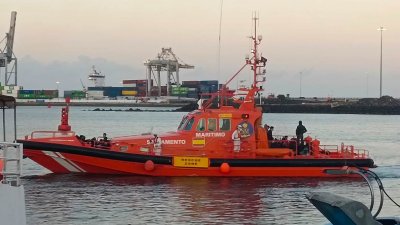
The Las Palmas Court has refused to convict two citizens of Gambia accused of being the skippers of the patera with which they arrived in Lanzarote, taking as evidence only the word of two protected witnesses, who they believe may have pointed them out so that they would not be prosecuted or to achieve the benefit provided for in the law of not being expelled from Spain.
In a ruling of July 23, which EFE has had access to, the first section of the Court examines a case very common in irregular immigration trials that have been held practically every week for years in the Canary Islands and elsewhere in Spain.
Specifically, it is the case of alleged skippers of pateras or cayucos whom the Prosecutor's Office accuses only - or mainly - with the testimony recorded at the beginning of the procedure of fellow travelers who are granted the status of protected witnesses and who are then not summoned to the trial, as their whereabouts are unknown.
In the grounds of the judgment, the presiding magistrate, Victoria Rosell, stresses that this is a "usual" situation and acknowledges that it is legally possible to issue a conviction without more evidence than the recorded statement of one or more protected witnesses, especially if there are other indications that corroborate their version.
In the province of Las Palmas, the Prosecutor's Office usually asks for six to eight years in prison for those prosecuted for skippering a patera and rarely suggests, from the beginning, the mitigated penalty provided for those who do not profit by taking the helm, but only seek to pay for their own passage. However, it usually offers lesser sentences to those who confess to being guilty and accept agreed sentences.
In this case, the two defendants, two young men aged 25 and 24, always denied having steered the patera, handled its GPS or having any other participation in the organization of that crossing. One of them even stated that he had spent almost all the time vomiting and dizzy, unaware of what was happening around him.
The Court points out that, although legal, the procedure by which these two witnesses recognized the defendants as skippers of the patera presented some shortcomings that compromised the right of defense, such as, for example, that they spoke in French with translation only into Spanish, when the two defendants only understand soninké and wolof (and one of them, this last language with difficulty).
"The carrying out of the pre-constituted test in another language, hearing it from another room of the court different from that of the two protected witnesses and without translation, allows reasonable doubts as to whether the defendants were able to understand the pre-constituted testimonies and, therefore, exercise their right of defense," the court argues.
But, above all, it lacks indications that corroborate these testimonies, such as fingerprints taken from the patera's engine (which was abandoned at sea), statements from other occupants, possible photos taken by the Salvamento plane where it could be seen who was steering, or even images or videos extracted with legal guarantees from the mobiles of those who were on board that could help dispel doubts about who was governing the boat.
Without any of this - and taking into account that the protected witnesses contradicted each other in some striking detail, such as whether or not they were threatened with machetes when boarding on the coast of Tan-Tan, Morocco - the Las Palmas Court questions whether their statement is reliable.
The court recalls, in this regard, that both had already opened the file for return to their country and that "their statement could lead to their own exculpation or even additional benefits" provided for in the Immigration Law, which offers the immigrant who collaborates with the authorities in this type of case the protection of not being expelled from Spain "if he denounces the perpetrators or collaborators" of crimes of trafficking in persons and testifies.
The Las Palmas Court is not the first court to raise these doubts. The judgment cites, in fact, a resolution this year by the Baleares Court that ruled the same in a similar case, in which the accusation was based only on protected witnesses.



Add La Voz de Lanzarote as a preferred Google source.
Stay informed with the latest current news.