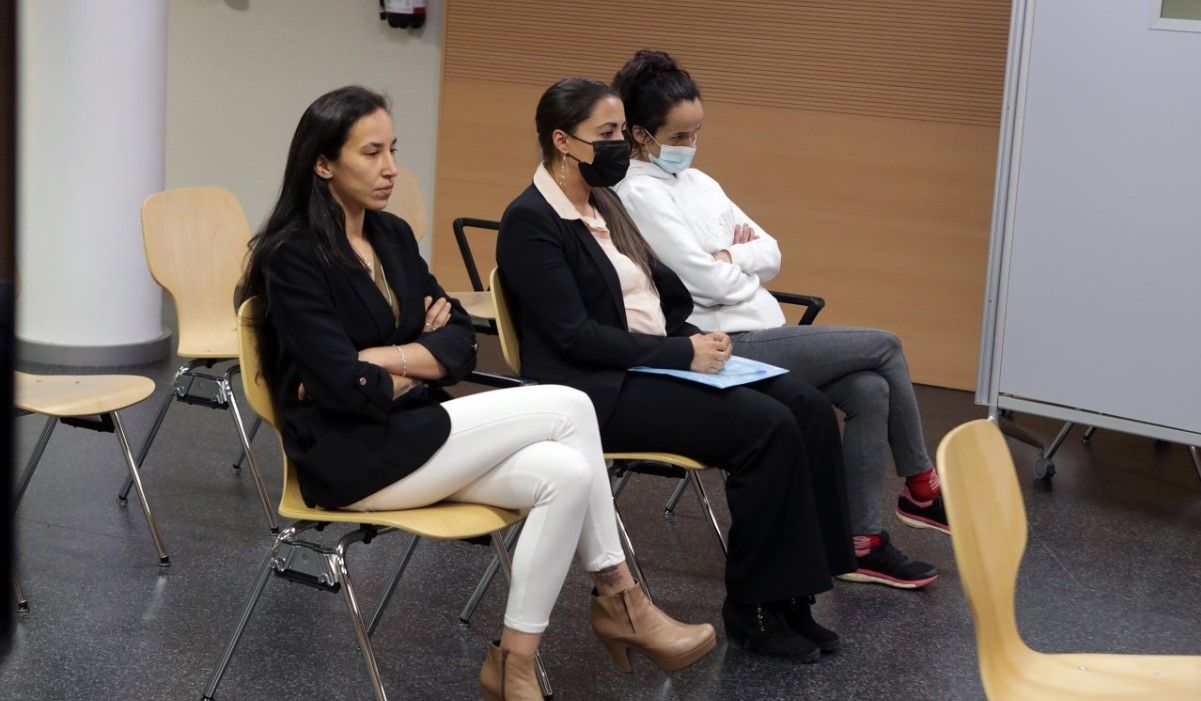
"They went to buy the gasoline can. They were the ones who set fire to the house. I didn't leave my house." That is what one of the three defendants in the arson of an occupied house in Argana declared this Thursday, thus blaming the other two defendants for what happened, who have pleaded not guilty.
The trial, held before the Second Section of the Provincial Court, has already been seen for sentencing, after a session marked by contradictions and even clashes between the defendants themselves and between the witnesses - almost all residents of Argana who live as squatters in different houses - and also by the warnings of the magistrate presiding over the hearing, who even threatened to clear the room on several occasions.
Both one of the defendants and several witnesses - who after testifying have remained in the public area - have made continuous gestures and even comments of disapproval aloud while listening to other testimonies or the intervention of the prosecutor and some defense attorneys.
In fact, two of the witnesses, who in turn are the victims of the alleged crime, have been expelled by the judge, after receiving several warnings. The same ones that one of the defendants, Estela O.G, has had to listen to on several occasions, who is the one who blames the other two for the fire. In her case, she even interrupted one of the witnesses while she was testifying, trying to refute her testimony.
In her statement, Estela acknowledged that the gasoline can allegedly used for the fire and the clothes worn by another of the defendants that night appeared in her home, but denied having anything to do with it and claimed that the others left it there. "Why would I set Carolina's house on fire? I have nothing against Carolina. What's more, her brother is my best friend," she declared.
A robbery prior to one of the defendants, the alleged motive
Regarding the alleged motive of the other two defendants - Cheyene C.V. and Aroa M.U. - who were a couple, it would presumably have been in a robbery that Aroa suffered a few days before in her house, in which, among other things, a laptop was taken. According to several witnesses, Aroa blamed one of the victims - who was Carolina's boyfriend and lived with her in the burned house - and even claim that she had threatened him if he did not return the computer.
Regarding Cheyene, the complainants have indicated that she had the keys to their house, because she had lived there with Carolina, but then they argued. Both have stated that they asked her to return the keys, but she did not. For this reason, the two have agreed that from the first moment, when they returned from work that morning and found the fire, they thought of the two of them as perpetrators.
According to them, the police and firefighters were already at the house when they arrived, and they told them that the fire had been caused by gasoline. Then they went to the Disa gas station in Maneje, where they claim they showed the employee photos of the defendants, and he recognized them.
For his part, the worker has also testified as a witness and has only partially confirmed that version. According to him, they showed him only one photo, that of Cheyene, which was the one he recognized, since she was a "regular customer". In the trial he confirmed that this defendant was buying gasoline that night, and that she took it in a can.
He has not identified Aroa, and has specified that at night the gas station operates with self-service, so he was inside the premises and could not see if more people were with Cheyene or if there was also a car. The images from the security cameras have also been provided to the procedure.
"Cheyene appeared at my house desperate"
For her part, Estela has stated that the other two defendants showed up at her home that night after the fire. "Cheyene appeared at my house desperate and asked me if she could change clothes," she said, noting that the other defendant, Aroa, had arrived shortly before.
In addition, although in her last turn to speak she stated that they left a backpack in her house but that she did not know what it contained, she had also said before that previously by telephone, they asked her to pick up a can of gasoline that was "under a car", although she added that she did not.
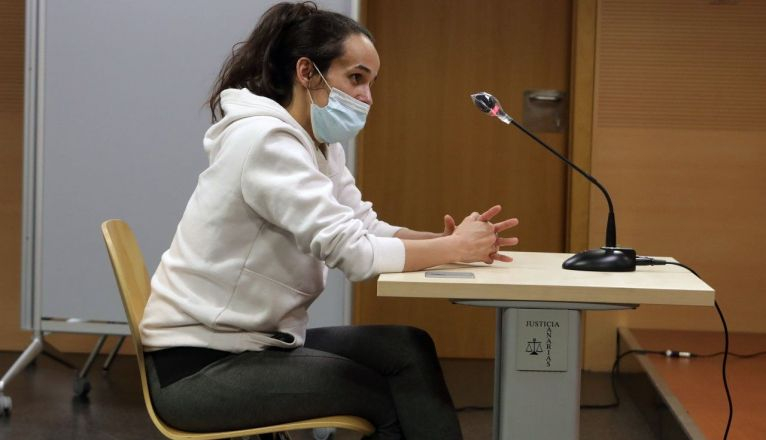
For her part, Cheyene has refused to testify, while Aroa has done so and has denied having participated in any way in the fire. This last defendant has been pointed out by several witnesses as the "mastermind", and they have even pointed out that she had also previously had an intimate relationship with Carolina, one of the victims.
As has been highlighted during the trial, the defendants, the complainants and some witnesses were related to each other, which in many cases went beyond friendship, and in a crossed way.
In the case of the defendants Cheyene and Aroa, everyone has agreed that they were a couple, but the discrepancy is whether they had already broken up or not when the fire occurred. According to Aroa, they had already broken up by then, she was living at her sister's house - who has also testified in the trial - and she did not even see Cheyene that day. According to other witnesses, Cheyene and she were still living in the same house, and acted together that night, in an alleged revenge against the victims.
"An embarrassing spectacle" but "no evidence", according to the defense
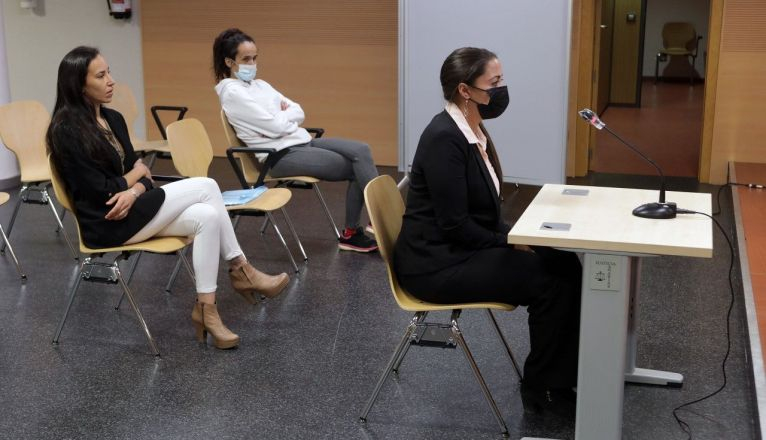
"I told you, she told me, I told him, I got angry..." This is how one of the defense lawyers summarized the trial in her conclusions, questioning that there is "no valid evidence" that incriminates her client, beyond what she considers "an embarrassing spectacle between the defendants and also the complainants", who "hid their relationships from each other".
"These women accuse each other," she said, arguing that the fact that a witness has "the intimate conviction" that a person has committed a crime, "is not evidence in a criminal court", which cannot be guided by "the nosy neighbor".
Regarding the evidence, she pointed out that the fact that Cheyene bought gasoline that night does not mean that it was to cause the fire. And regarding the discovery of Cheyene's clothes and a container in Estela's house, she does not consider it to be decisive either. "The rest is not enough to condemn people," she argued, insisting that there is no evidence or witnesses who actually saw them cause the fire, beyond the comments that were made within the "gang", in which there were important "grudges". In fact, some have changed in the trial the testimony they gave during the investigation, and another has gone on to not remember absolutely anything from that night.
Regarding the messages that Aroa sent to her ex-partner with phrases such as "I'm going to kill you", "I hate you", "don't leave me alone", the lawyer has indicated that "they cause embarrassment, but that it is not enough to accuse" someone.
For his part, Cheyene's lawyer has also maintained that there is no "direct evidence" against his client, and considers that she also did not have a "motive" to cause the fire. Regarding the evidence that places her at the gas station that night, he has referred to witnesses who have stated that it was for "a friend's motorcycle that had broken down", although Cheyene herself has not testified, and therefore has not answered that question either.
"If my client was going to cause a fire, does anyone think that she could go to the gas station where she was a regular customer?" her lawyer questioned.
Regarding Estela's lawyer, he has argued that she does not appear in any video recording and no one has placed her at the gas station. Also that the witnesses have named her "little" and that she "had no relationship" with the victims, although she did with the other two defendants, who according to her own statement went to her house after the fire.
Neighbors evacuated due to the fire and a dog died burned
During the hearing, several experts, as well as firefighters and agents of the National Police who went to the house after the fire, have also testified. "If it had not been extinguished quickly, it would have affected the entire building," one of them said.
In fact, the neighbors had to be evacuated. Two of them, father and son, lived in the house opposite and have also testified in the trial. In the case of the young man, he explained that he heard noises around 2 in the morning, and thought they were his neighbors, but 10 minutes later he heard someone leaving again and the door closing, and that's when he started to worry, because he kept hearing noises inside the house
"Yes, I was scared," he said. When asked by the prosecutor, he confirmed that those noises that he continued to hear after hearing someone leave could be from "explosions" and objects falling due to the fire, although the first thing he thought was that someone had broken in to steal.
At that moment he woke up his father, who knocked on the door of the house without anyone opening it. Later, through the patio he saw the flames, and that's when the firefighters were notified.
The flames and gases - which one of the firefighters has underlined the serious danger they can entail - did not cause personal injury, but the victims' dog did die burned in the fire.
During the investigation, the young neighbor stated that the animal could be heard barking non-stop, until it stopped doing so.
In addition to a sentence of 13 years in prison for each of the defendants, the Prosecutor's Office is asking for compensation of 100 euros for the death of the dog and 938 euros for the movable property that was burned; as well as another 14,251 euros for the owners of the house, for the damage to the house.
In her conclusions, the prosecutor has argued that the facts have been proven during the trial and has ratified the request for punishment for each of the defendants, pointing to all three as perpetrators of the crime of arson.



Add La Voz de Lanzarote as a preferred Google source.
Stay informed with the latest current news.