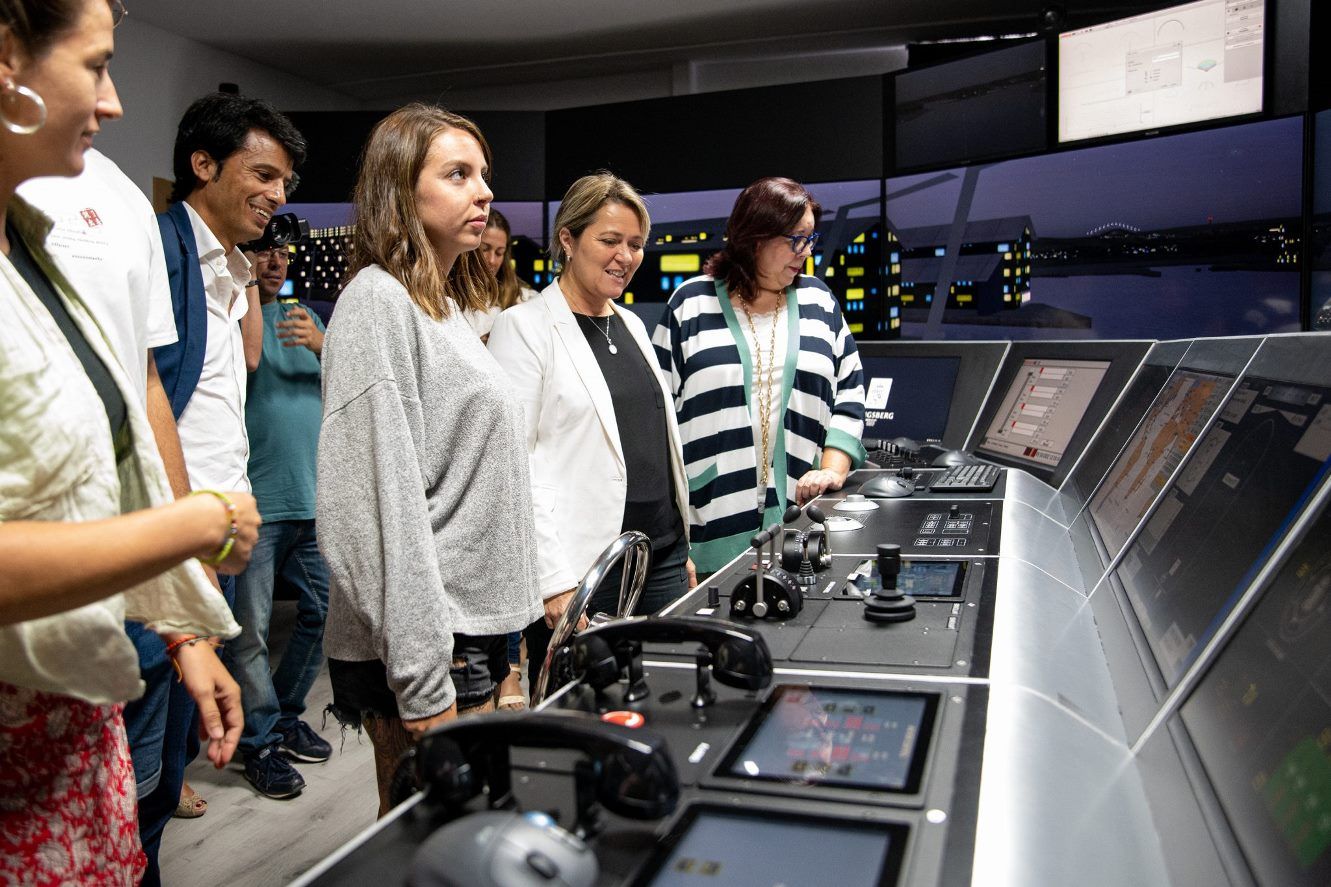
This past Friday, the Ministers of Agriculture and Education of the Government of the Canary Islands inaugurated the new academic year at the Arrecife Fishing School, which for 2022/23 has a training offer of seven intermediate-level cycles and five higher-level cycles for both centers and a total of 326 students.
Alicia Vanoostende highlighted during her speech "the regional Government's firm commitment to innovation and modernization as an essential pillar to face the new challenges of the sector through the implementation of dual training in the agricultural and fishing field, which contributes to a more guaranteed incorporation into a constantly changing labor market."
Finally, Vanoostende emphasized the importance of promoting the primary and tourism sector binomial: "We have to put a lot of effort and enthusiasm into revaluing our local product, both to residents and tourists; we have a nearby, fresh and high-quality product."
For her part, the Minister of Education, Culture and Sports, Manuela Armas, highlighted the trajectory of this educational center, which has 80 years of history and is a national benchmark in these studies. She also emphasized the commitment to new technologies in the teaching of these subjects, which have a group and 16 more students in this school in the current academic period, and congratulated the students for choosing essential studies in achieving the objectives of sustainable development, while stressing the importance of fishing activity for the islands, "and the primary sector in general."
After the opening ceremony of the course, the professor of the Department of Sociology and Anthropology of the University of La Laguna (ULL), Raquel de la Cruz Modino, gave the presentation 'Fishing in the Canary Islands: opportunities and challenges in the 21st century'.
Presentation of the Bridge simulator
Vanoostende and Armas visited the center's facilities and attended the presentation of the Bridge simulator, a novel system for maritime-fishing teaching in the Arrecife center that simulates the bridge of 20 merchant or fishing vessels in any weather or navigation condition and that generates a real atmosphere in each exercise with the reproduction of scenarios such as Hamburg, the Strait of Gibraltar, the Bosphorus Strait or San Francisco, among others.
This equipment is used by students of the Bridge training cycles; the Higher Level Training Cycle in Maritime Transport and Deep-Sea Fishing; the Intermediate Level Training Cycle in Navigation and Coastal Fishing, in addition to professional courses such as Fishing Captain, Multipurpose Coastal Skipper, Local Fishing Skipper and Fisherman Seaman (bridge watch simulation).
Its cost amounts to 310,000 euros and has been financed by the Ministry of Agriculture, Livestock and Fisheries of the Government of the Canary Islands.
Improvements in the institutes
The Ministry of Agriculture, Livestock and Fisheries has promoted different improvement works in the two institutes of the Canary Islands. In the center located in Santa Cruz de Tenerife, it has carried out different works to expand the classrooms, in addition to the acquisition of new technical and scientific material for the development of the teaching activity, among which are a maritime communications simulator and a specific navigation program used in fishing vessels.
For the Arrecife center, in Lanzarote, photovoltaic systems will be installed to improve the energy efficiency of the center, in addition to acquiring a maritime radiocommunications simulator and carrying out improvement works on the dock esplanade.
Add La Voz de Lanzarote as a preferred Google source.
Stay informed with the latest current news.