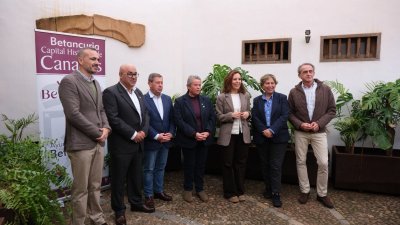
The Minister of Tourism and Employment of the Government of the Canary Islands, Jéssica de León has signed a collaboration agreement with the five Canary municipalities integrated into the network of the Most Beautiful Villages in Spain. The minister was accompanied by the Director General of Infrastructure, Sustainability and Tourist Quality, Héctor Mateo, and the CEO of Gesprotur, Ignacio Solana.The event took place at the Shoemaker's House, in the Town of Betancuria, in Fuerteventura, one of the signatory municipalities, and in addition to the mayor of this town, Enrique Cerdeña, the mayors of Tejeda, (Gran Canaria), Francisco Perera; the mayor of Agulo, (La Gomera), Rosa Chinea and the deputy mayor of Teguise, (Lanzarote), Rita Enma Hernández attended it.Alongside Garachico, in Tenerife, these five municipalities are part of the national network of the Most Beautiful Villages of Spain, an association made up of 122 municipalities that works for the conservation, dissemination, and promotion of the valuable rural, cultural, and natural heritage of these destinationsThe agreement establishes a framework for cooperation between the Ministry of Tourism and Employment and the five municipalities with the objective of promoting actions in terms of tourist infrastructures in these towns integrated into the network of the Most Beautiful Villages in Spain
"It is the first in all of Spain," explained Jéssica de León, and she highlighted that "these towns have a profoundly Canarian feeling, a tradition, culture, and heritage that we must preserve." In this regard, the Minister of Tourism and Employment emphasized a recent study by her Department to promote rural tourism, from which she highlighted that "we must allocate funds so that these municipalities can restore that heritage, can enhance and rehabilitate it, and unify criteria in aspects such as facade conservation or signage"
Jéssica de León explained that "the agreement will act as a strategic and organizational instrument that defines common objectives, intervention criteria, and priority lines of action, ensuring they are aligned with the Canary Islands Strategy for Island Tourist Infrastructure".
In addition, he indicated that "the agreement seeks to **improve the urban, landscape, and functional quality of historic centers, reinforce accessibility and environmental integration,** and consolidate a unique tourist image based on the heritage, cultural, and landscape value of these municipalities, placing the resident as the main beneficiary of the actions"
For his part, the Director General of Infrastructure, Sustainability and Tourism Quality, Héctor Mateo, stated that "the interventions are structured in areas such as the improvement of lighting and security, the burying of cables, the aesthetic integration of waste containers, the organization of parking lots, the creation of green areas, the improvement of accessibility, the provision of public restrooms, and the organization of traffic and urban access"
Likewise, he indicated that "from an operational point of view, the agreement sets clear commitments for the parties where **the city councils must present projects** aligned with the defined lines and with all the necessary documentation, guaranteeing their maintenance and public use, while the Ministry of Tourism and Employment will provide technical support and promote actions that comply with the established strategic criteria".On the other hand, the financing of the actions is not included in this framework agreement, but rather will be arranged later by defining the amounts, the economic obligations, and the execution conditions of each specific projectIn addition, a parity Monitoring Commission will be created, responsible for the supervision, evaluation, and control of the agreement, as well as for the preparation of annual monitoring reports. The agreement will have an initial term of four years, with the possibility of extension



Add La Voz de Lanzarote as a preferred Google source.
Stay informed with the latest current news.