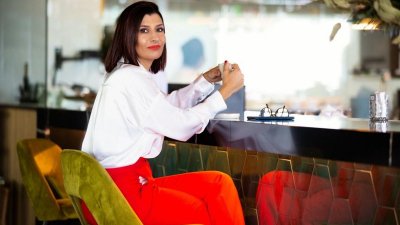
Vanessa Arrocha from Lanzarote is the owner of Ava Selección, a company that obtains food products for the island's chefs. It is a distribution company, but with a consulting spirit. Since her days as a Marine Science student, Arrocha has always liked to bring products that could not be found on the island.
In an interview on the radio program Más de Uno Gourmet on Radio Lanzarote, she highlights Lanzarote's transformation in terms of the availability of gastronomic products and recounts the daily challenges she faces in bringing fresh products in a timely manner so that her clients can complete their menus.
- How did the idea of creating Ava Selección come about?
Since my student days when I traveled as a backpacker, what I remembered most from my trips was the food. I liked to bring things from outside and visit gourmet shops.
I was born in Lanzarote and I have grown up here. Forty-odd years ago, the island was not what it is today, there was a lot of product scarcity.
"Until 15 years ago, in Lanzarote you could practically not eat anything outside of the same old thing"
- For some time you ran the family business, Africamar, how did it influence this project?
I studied Marine Sciences and I really liked discovering the more scientific and natural side of the world, but after the death of my father, which was something I did not expect, I returned to Lanzarote and started working at Africamar. That's how I started to have contact with the business world.
They were years of a lot of learning and a lot of emotions, because I had to maintain what my father had built. After a few years, there came a time when the business model was no longer viable, due to competition. I also think we lacked business culture. That has been an important lesson in my life.
- What are the main challenges you faced when creating Ava Selección?
Until 15 years ago or so, in Lanzarote you could practically not eat anything outside of the same old thing.
The people here were not used to eating certain things. Thanks to the Saborea Lanzarote project, the mentality of the hotelier, the restaurateur and the cook, of the sector in general, has changed. Saborea Lanzarote has undoubtedly played a fundamental role in the gastronomic evolution of the island.
- So communication was fundamental...
The fact that it was so difficult gave me more motivation. We have always had the vision of reaching the client more as consultants than just distributors.
Not always the one who is going to use the product is the one who buys it from you or vice versa. That is why we have to build a chain of value, knowledge and continuous communication between everyone.
"The hardest thing for me to bring has been French oysters"
- When did you start with Ava Selección?
My independent path begins in the time of covid. We had closed and ended the Africamar chapter of the family business.
I had had a very, very bad time, it was not easy at all, but the covid break gave me time to prepare and launch this new project.
- Why Ava? What does it mean?
Ava are the initials of Aquilino and Vanessa Arrocha. My father died very young, of a sudden cancer and was an important figure in my house and in my family. For me he has been someone to follow, a pioneer.
Then I looked for ava on the internet and discovered that it means 'giving life' in Greek, so it was clear that the name was this yes or yes.
- What was the first product you brought with Ava Selección?
The first thing was to make a lot of phone calls. Over the years I have met a lot of people at fairs and when I told them what the company was going to be, a lot of people supported me, and suddenly, I found myself with a lot of brands and a lot of products.
It was not just one. Perhaps the part of Sosa and Valrhona selection that is equally the most technical within a kitchen, there I had a lot of support were products that were difficult to get here.
"When importing perishable products, you have to have all the unforeseen events prepared to anticipate the obstacles that may occur along the way"
- What products does the company's current portfolio include?
This year we held an event to present all the products, the Yellow Day. We had 26 brands, in addition to the assortment of products that are not linked to any particular brand.
My intention is to be able to supply 80% of a client's menu and always have a small window open so that if they need something very exclusive, very specific, they can get it quickly.
- What product has been the hardest for you to get?
The hardest thing for me to bring has been French oysters, specifically the Gillardeau, which is the oyster par excellence. It is a very difficult product to bring fresh here. They were asking us for it from Gran Canaria because our line is already focused on the entire province of Las Palmas.
Another very difficult request was made by Víctor Bossecker when he was chef at Isla de Lobos. He told me: "I need some chicken castañetas for next week for a German who is coming to do some gastronomic days on the island. Until I found out what they were and was able to get them... They are the chicken culetes, I had to find someone who had them and be able to get them here, it was the biggest odyssey.
- What is the logistical process for bringing products to Lanzarote?
You have to take into account the shelf life of the product, how it has to be transported and by what means you are going to bring it. You also have to assess the costs, there are things that become so expensive with logistics that they are unfeasible if there is no minimum volume.
Then there are the customs procedures, taxes and duties that we have, because we are in Spain, but at customs level everything is imports. This entails a huge problem for perishable goods if for whatever reason a document is not correct, the inspection wants to see the product or withholds it.
It can also happen that there is a storm and the ship does not arrive or that the dispatch is not correct on the plane, or as there are schedules at the airport, it is past the hour and there is no cold here to keep it for you and they do not keep it for you... there can be 20,000 inconveniences, which are many risks. You have to have all the unforeseen events prepared to anticipate the obstacles that may occur along the way.
- And what is it like to send products from Lanzarote to chefs abroad?
We have made shipments to the peninsula and Portugal. A lot of phone calls, a lot of follow-up, always looking for the way, even if it is not the least expensive economically, of a logistics with people you trust.
Also when you import, the product arrives at your house, you see how it arrives and then you supply it to the chef, but when you send it, you are not going to see how it arrives. Also when exporting, Ava is blurred, it is the Lanzarote brand that prevails. Then the responsibility is even greater.
Add La Voz de Lanzarote as a preferred Google source.
Stay informed with the latest current news.