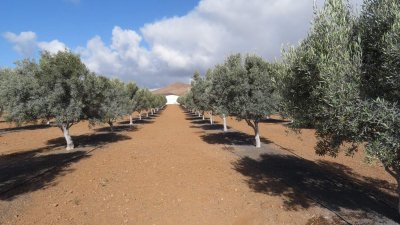
In 2012, the Cabildo of Lanzarote launched an ecological olive grove project to diversify the agricultural production of the island. In the first year alone, 12,000 olive plants were distributed in three phases, from nurseries in Valladolid and Seville. To this day, 32,000 olive trees have already been distributed.
The Cabildo estimates that half, about 16,000, continue to thrive on the island, many others have not succeeded, largely due to water cuts to agriculture that have intensified in recent years.
Currently, there are four commercial brands that produce oil in Lanzarote: Caldera de Arroyo, Vereda de Conil, Tinguatón, and Finca El Refugio, which began its activity in 2024.
Before that, “the presence of olive trees in Lanzarote was testimonial, there were some olive trees in La Geria and in isolated farms”, shares Ana Garrido, technician of the Island Agricultural Service, in an interview with Ekonomus.
It is estimated that currently about 50 hectares in Lanzarote are covered by olive groves. Most of the productions are small, the commercial brands sell it as a gourmet product and the family plantations are for own consumption.
Lanzarote produces between 3,000 and 5,000 liters per year
The Cabildo's oil mill, the only one at an industrial level on the island and which is used by all producers, began operating in 2014. In the first campaign, 3,700 kilos of olives were processed, which resulted in 276 liters.
Since then, “both the kilos and the liters have fluctuated greatly each year”, explains Garrido. On the one hand, positively, because the number of olive trees and their size was increasing and on the other, negatively, due to the characteristics of the plant itself that alternates years of great production with years of little harvest.
“The year of maximum production was 2021 when we collected 43,519 kilos which resulted in 5,035 liters. In the last harvest last year there were 27,900 kilos and 3,039 liters”, specifies the agricultural technician of the Cabildo.
The olive season begins in mid-August in Lanzarote with the arbequina variety and often overlaps with the grape harvest. Last season, a total of 24 producers brought together an average of 800 kilos each day to be processed. The Cabildo's oil mill needs at least 300 kilos in each one-hour pressing to function properly.
“As production is increasing, the Cabildo has decided to buy superior machinery and set up an even larger oil mill line”. The new oil mill will cost 236,000 euros and will allow processing up to 800 kilos per hour, instead of the current 300, and is expected to be ready for next year.
"Reaching 200 hectares would be a success"
Looking to the future, Garrido considers that “having 200 hectares of olive trees on the island would be a success, so producers would have a significant volume of oil that could be sold without difficulty and without saturating the market”.
Regarding institutional support, through the POSEI, aid of 550 euros per hectare can be requested from the Government of the Canary Islands for crops larger than 2,000 square meters.
The Cabildo of Lanzarote, for its part, in addition to the delivery of plants and processing through its oil mill, offers training sessions such as oil tastings, use of fertilizers and treatment of the olive grove, among others.
The first island institution also has a series of lines of economic support. One for operating expenses, which includes the acquisition of plants, fertilizers, picón or any type of phytosanitary treatment.
Another line is focused on investment expenses for irrigation facilities, windbreaks, tractors, and any type of small machinery they need for the operation. A third line is responsible for supporting investments in transformation “for producers who have a larger quantity and want to buy their own oil mill”, details Garrido.

Add La Voz de Lanzarote as a preferred Google source.
Stay informed with the latest current news.