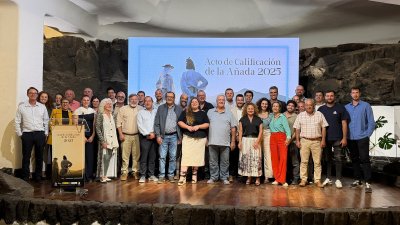
The Regulatory Council of the Designation of Origin Lanzarote Wines held this Monday, May 4, at the Casa Museo del Campesino, the Act of Qualification of the 2025 Vintage, an event that once again brought together the island's wine sector around the analysis and recognition of a particularly unique campaign.
The 2025 vintage was rated as “very good” after the tasting and evaluation of 23 wines (11 dry Whites, 4 Rosés, 4 Reds, and 4 semi-sweet Whites) references from different wineries on the island. The final result, with a score of 17.5 points, recognized the performance of a harvest that was short in volume but stood out for the quality of the grape and its enological expression.
During the campaign, 843,000 kilograms of grapes were harvested and 1,502,656 bottles were produced, in one of the smallest harvests in recent years. Although production was above the slightly more than 700,000 kilos recorded in 2016, it fell far short of the 3.3 million kilos reached in 2023, clearly reflecting the dimension of a limited harvest in quantity.
Furthermore, the Denomination of Origin currently has 1,821 registered winegrowers, 33 active wineries, and 1,889 hectares of vineyard in production, consolidating the sector's weight on the island despite campaigns of lower volume.
The event featured the screening of the docufiction Tras el Volcán, a piece that "delves into the uniqueness of Lanzarote's wine landscape and the link between the territory, tradition, and the effort of those who sustain this unique cultivation model".
Once the event concluded, attendees enjoyed a tasting of Lanzarote wines accompanied by other local products, in a meeting space that "allowed for continued highlighting of the quality and identity of the island's agri-food production".
The president of the Regulatory Council, Jorge Rodríguez, highlighted during the event that “the 2025 vintage once again demonstrates that in Lanzarote quality does not depend solely on quantity, but on the knowledge, effort, and commitment of an entire sector that knows how to overcome complex campaigns without losing its identity”.
Furthermore, he stressed that “behind every bottle there is enormous work in the vineyard and in the winery, and also a way of understanding wine deeply linked to the landscape and the history of this island. This vintage, although small, reflects very well that uniqueness and that level of demand with which we work in Lanzarote”.
For his part, the president of the Cabildo of Lanzarote, Oswaldo Betancort, who closed the event, highlighted that “Lanzarote wine once again demonstrates that, even in adversity, quality is maintained,” in reference to the 2025 vintage, one of the shortest in recent decades, but highly valued. During his speech, he also underlined the key role of winegrowers, wineries, and the Regulatory Council in conserving “an agricultural model unique in the world,” as well as the importance of knowing the origins of La Geria to face the future of the sector.
Likewise, he conveyed a message of optimism by pointing out that “the forecasts for the 2026 harvest are positive” and could allow production to recover if conditions are favorable. In this context, he highlighted the Cabildo's commitment to the sector, emphasizing the investment of more than 627,000 euros in aid for pit cultivation, with 342 beneficiaries, and defending that “defending pit cultivation is defending Lanzarote,” as the basis of a “heroic” viticulture that constitutes one of the island's main hallmarks.
Do you usually read us to find out what's happening in Lanzarote? Choose La Voz de Lanzarote as one of your reference media on Google



Add La Voz de Lanzarote as a preferred Google source.
Stay informed with the latest current news.