
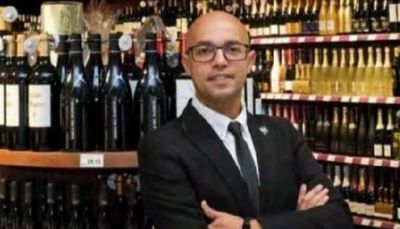
Iván Monreal from Gran Canaria, Iván Monreal, is the runner-up of Spain's sommelier competition and has just joined the restaurant of the Hotel Palacio Ico, in Teguise. In an interview on the radio program Más de Uno Gourmet, he explains what his profession consists of, as well as his European journey to train in this profession and the keys to providing excellent service.
- What exactly does the sommelier profession consist of?
Although this profession has diversified a lot, I call it the waiters of wine, those of us who have always worked in the dining room, accompanying diners at lunches and dinners, advising them on what they should drink to accompany what they are eating.
In addition, sommeliers are not only experts in wines, but we also control the issue of liquors, spirits, coffees, cigars... so that diners have a unique experience.
- How did you become a sommelier?
At 17, I emigrated to Germany because I wanted to learn German and I started working in an Italian restaurant. There was a sommelier there who was the president of the Italian association of the German region where I was, and I started studying with him.
"In Germany or Switzerland, a good sommelier or a good head chef is no less than a doctor or a lawyer"
- How does one prepare for this profession?
There are two fundamental parts, the theoretical and the practical. The theory is the most complicated. We not only study the world of wine, but also cheeses, olive oil... Everything that is gastronomic products to be able to advise wines adequately.
The practical part consists of having a lot of training with tasting, to refine the senses and identify the wines by their elaboration or by their origin.
- Where have you studied?
First, in Germany, I studied Italian and prepared with the Italian association of sommeliers. Then I studied at the Spanish School of Tasting in Madrid. I have also been studying in France. Right now I am fully involved with the Court of Master Sommeliers, one of the most prestigious institutions in our sector worldwide.
"In a championship you have to identify the origin of the product and describe it. Make a good visual, olfactory, gustatory phase, propose a pairing, the service temperature, the optimal time of consumption..."
- How did you become the runner-up of Spain?
The truth is that almost my entire career had been spent working in different European countries and something I had not done was to attend championships.
But when I returned to the Canary Islands I started to present myself and I have been champion of the Canary Islands the two times that the championship has been held. I am also the runner-up of Spain and of the Ruinart Sommelier Challenge, one of the most prestigious competitions internationally.
- How is a sommelier championship organized?
The Spanish Championship, for example, brings together the champions from each Spanish region in Madrid, where a semifinal is organized. This consists of a theoretical exam and then there is a blind tasting of a white wine, a red wine, and a product from any part of the world.
The product can be a whiskey, a calvados, a vermouth, it can be anything. Once the semifinal is over, the 10 best sommeliers in Spain are named. From there come the three finalists, who do a series of tests on a stage with an audience: correction of an erroneous menu, tasting, pairing, decanting...
- What exactly does a tasting in a contest consist of?
On the one hand you have to identify the origin of the product, but also describe it. Make a good visual phase, a good olfactory phase, the gustatory phase, the pairing, the service temperature, the optimal time of consumption...
If you manage to guess the origin and the vintage are extra points, but I think the basis of the tasting is to make a good description of all the parameters.
"The volcanic Malvasia is the only grape native to the Canary Islands and has a unique identity, which gives rise to wines with identity"
- How do sommeliers collaborate with oenologists?
Oenology is the part of wine production, of technology. It is a fairly complex university degree. A sommelier should know at least the basic steps for making a wine.
Sommeliers make visits to wineries and learn from oenologists. Many times if you open a bottle and detect that the wine has a lot of tannin or high acidity that may not correspond 100% with that area, the oenologist will explain why.
In fact, one of the reasons for my move to Lanzarote was that apart from continuing to work in the dining room, I can be in contact with wineries and oenologists.
- What peculiarities does the volcanic Malvasia of Lanzarote have?
The vast majority of the grape varieties that we have in the Canary Islands were brought by Portuguese and Spaniards. However, the volcanic Malvasia is the only one that is native to the Canary Islands and has a unique identity, and gives rise to wines with identity.
- How do you advise customers once they are seated at the table?
I usually go to the table first at the time of the aperitif to suggest sparkling wines, Jerez wines... and the second time to take the wine order, once I know what the customer is going to eat.
There are many types of red wine and white wine. In the market there are red wines that can go perfectly with fatty fish. The important thing is to develop a varied wine list. There are many restaurants that have 60 wines, but they are 30 riberas and 30 riojas, so they have many references, but they do not have variety.
Ideally, if you have a tempranillo from La Rioja or Ribera del Duero, you should also have a mencía from the Ribeira Sacra, which are much fresher wines, with more acidity and less tannin. This way you can have a palette of wines that allows you to play.
- Tell us about your participation in the Saborea festival with Palacio Ico...
I have just joined Palacio Ico and we are going to give a presentation in which we will present the new project. We have a fairly high level of cuisine, and with my incorporation we seek to improve the service and beverage part and we will present the present project and especially where we want to go in the future.
The restaurant of the Hotel Palacio Ico has a great dynamism and wants to contribute to creating a gastronomic culture, through conferences with invited chefs, workshops, presentations, tasting menus...
- What would you say to young people to encourage them to dedicate themselves to this working world?
When I go to give presentations to the institutes I always say it, the hospitality industry well done, with passion and with affection can be a profession of great prestige.
As a tourist region that we are, perhaps the value that should be given is not given, but in countries such as Germany or Switzerland, a good sommelier or a good head chef is no less than a doctor or a lawyer.


