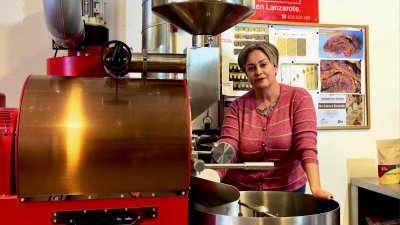
Elba Cabrera from Lanzarote joined the latest wave of coffee, the 'specialty coffee' wave, and inspired by the places she visited while traveling, she opened the coffee shop with its own roaster Der Coffee eight years ago in Puerto del Carmen. There, her clients learn about the origins and processing of the coffee they taste, which can have notes of caramel, chocolate or licorice, but never tastes burnt.
In an interview with the radio program Mas de Uno Gourmet of Radio Lanzarote, Cabrera explains how she decided to open her business and shares the main differences between commercial coffee from supermarkets and the specialty coffee offered by coffee shops such as Der Coffee.
- How did you become an expert in quality coffee?
I am from Lanzarote, from the town of Tías. I trained in cooking and spent many years working in restaurants on the island and also in Madrid and Barcelona with Michelin-starred restaurants.
While traveling, I realized that a new wave of coffee was emerging, called 'specialty coffee'. In London, I visited a place of this type, where people could smell the freshly roasted quality coffee.
- What are the advantages of specialty coffee?
In a specialty coffee shop, they only have quality, freshly ground coffees, and they inform you of the type of coffee you are drinking. This way, the coffee takes you on an incredible sensory journey of different notes, a quality coffee that does not need sugar or milk to hide the bitterness.
You can notice hints of caramel, chocolate, licorice, also the creaminess is different. In the London store, I spent a whole day analyzing the market and the feelings of people enjoying and repeating and I decided to transfer that model to my island.
- You compare the elaboration of coffee with that of wine...
At Der coffee people come to enjoy the coffee, its aroma, and to learn about its traceability and history.
It is similar, but coffee is paid worse than grapes. Coffee production has many coffee growers behind it who are fully dedicated to coffee, very humble families in Colombia, Brazil, Ethiopia... Many people are needed to collect a small coffee cherry.
- What are the differences between supermarket coffee and specialty coffee?
When a coffee plantation is planted that is intended for specialty coffee, there is rigorous control, for example over the water and fertilizer, which must be completely natural.
Once the specialty coffee has matured, the beans are selected for drying. Then comes the pulping and washing process, all by the hand of many experts who take note of the quality. That is, that it has sufficient density, that it does not come out threshed or with defects, etc. When the coffee reaches us, it has a score that always goes from 80 to 100 points.
- Does commercial coffee also receive points?
Commercial coffee has a score of 70 to 80, but it is not a reference, because it has many defects, for example from threshing, or from having had some insect on the plantation...
In addition, they do not take into account the roasting curve and do not do as many analyzes as we do. They roast it at a very high temperature, which is not ideal, which causes bitter notes in the coffee because it is burnt.
- Is it difficult to set up a business like this on an island like Lanzarote unlike a big city?
Lanzarote is currently booming in terms of tourism and it is precisely the tourist who already knows specialty coffee who is looking for us. They know that we do a fundamental job to preserve the grain and the health of each consumer. They can enjoy a coffee without the need for milk or sugar.
- Where does the grain from your coffee shop come from?
I bring a little from all origins, because coffees are seasonal and I always look for fresh coffees. Now, for example, I have made a purchase of coffee from Colombia, Guatemala and Brazil, which was collected at the end of 2023.
Commercial houses do not look at the year in which that coffee was collected, if it was collected two years ago, what we call old coffee.
- How do you roast the coffee?
The coffee arrives to me green and the first thing I do is an analysis of the altitude, the process and the variety. In a single batch there can be three varieties of Arabica. In specialty coffees we always work with Arabica, never with Robusta, which has more caffeine and is more bitter.
We also look at the history of the coffee plantation, the food it has had... Based on all these parameters we calculate the density to know what our roasting curve will be.
The density tells us at what charging temperature we should put that coffee and at what time we should take it out so as not to burn it.
- Can those who visit you know how the roaster works?
Of course, when our customers come to buy coffee I always try to show them the roaster, the different green beans, and then let them see the roasted coffee.
It is very important that they know where that coffee comes from, in which machine it is being roasted.
- Are there good coffee producers in the Canary Islands?
Yes, we used to think that Agaete was the only plantation in Europe, but there is specialty coffee for example in Tenerife, in the Garachico area, and in Agüime, in Gran Canaria.


Add La Voz de Lanzarote as a preferred Google source.
Stay informed with the latest current news.