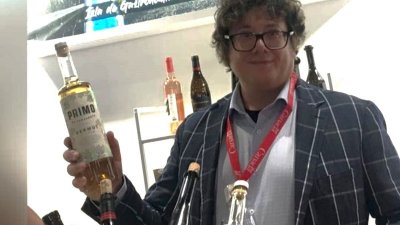
Davide Musci, originally from Turin, the cradle of vermouth, is a lover of gastronomy and in love with Lanzarote. When he got tired of the big city (Rome) he decided to move with his partner, his cat and a 4-month-old child to the island, where he created the vermouth Primo de Lanzarote, made with wine from the island. He produces it in white and red, whose intense ruby color is achieved thanks to the prickly pear and palm honey.
In an interview with the Radio Lanzarote program Más de Uno Gourmet, he explains how it is made and how he has managed to make it an essentially Lanzarote product.
- Good morning Davide, how did you get to Lanzarote?
I came to Lanzarote because of my love for the island. I used to come on vacation once or twice a year until I got tired of the big city. I was living in Rome, a very beautiful city, but very complicated.
"I had a cooking show on Italian television"
After 12 years in Rome, I needed a change. So I talked to my partner and we decided to move in 2011, with a cat and a 4-month-old child, to the small paradise that is Lanzarote.
- You have a career very linked to gastronomy…
Yes, gastronomy is in my DNA. In Rome I had a small gourmet restaurant for 5 years and before that I had a cooking show on television. My family raised me by introducing me to local products, restaurants, wineries... so I have always loved this world.
"There were always flavored wines for healing purposes, but in Turin vermouth was created in the late 18th century for enjoyment"
I am from Turin, where vermouth was born, as we know it now, at the end of the 18th century. There had always been wines flavored with herbs for healing purposes, since ancient Greece, but it is in Turin when it is created for recreational purposes, for enjoyment.
- How did the idea of creating a vermouth in Lanzarote come about?
While enjoying the wines of Lanzarote and the landscape of La Geria, the idea came to me. I decided to represent Lanzarote in the world of vermouth, betting on a quality wine. I already made homemade liqueurs for personal use and I started experimenting with wine and macerations of herbs, some from the island.
"Vermouth comes from the German word wermut, which means wormwood, its main herb"
The main herb of vermouth is wormwood, which is called wermut in German, the origin of the word that defines the drink. It contains herbs that come from all over the world: cinnamon, nutmeg... But I, for example, use orange peel that we have available in autumn in Lanzarote. Coriander, sage... They are also local and especially the wine, 100% from Lanzarote.
- Do you make it with Malvasia grapes?
Yes, I have started with Malvasia grapes and a part of Diego. Always quality wine that can represent Lanzarote. The first vermouth was white and I decided to keep in it the characteristics of the wine and the volcanic Malvasia both in smell and taste.
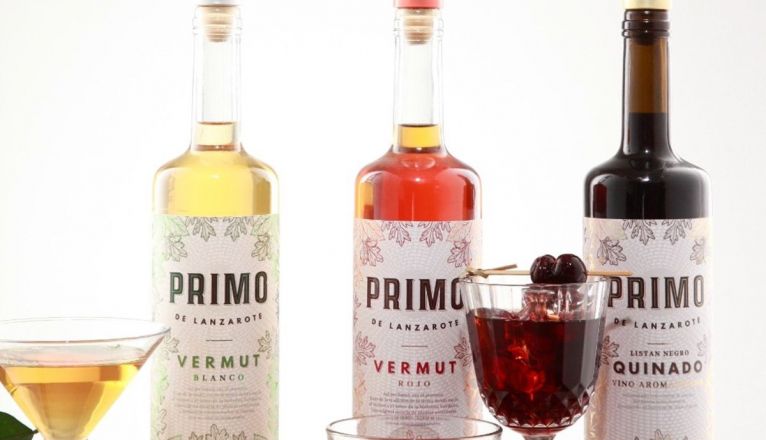
- How many references do you have?
I have three. The white vermouth, the red vermouth, whose base is the same, volcanic Malvasia and Diego, changes the maceration of herbs and spices. The white is a little softer, a semi-sweet you could say, and the red is more bitter.
Red vermouth is traditionally made with white wine, to which caramel is added. The reason is that at the beginning of the 19th century, when vermouth began to travel from Italy to America for the Italian diaspora, to prevent the color from changing, they decided to give it a fixed color.
"The color of our red vermouth is achieved with prickly pear and palm honey"
It occurred to me to use prickly pear and palm honey to give it color, local products, which give it its characteristic ruby color. The third reference is quinine wine, made from black listán, but we won't have it until next year.
- How is a Primo de Lanzarote vermouth made?
Vermouth is a flavored wine, so the base is wine, which is 85% of the product. Alcohol is added because it is a fortified drink and by law it must have a minimum of 15 degrees.
It is made with dry white wine. I have to thank Francisco Perdomo from the Perdomo wineries very much, who was the first to provide me with a wine for my experiment.
"I wanted to create a product very anchored to the territory, to Lanzarote"
The other ingredient is herbs, which are macerated cold. I do the maceration in alcohol, some do it in wine. That alcohol macerated with herbs is filtered and added to the wine. You have to add sugar by law and as I said a little alcohol to reach 15 degrees.
- Is it difficult to make vermouth?
The process is relatively simple, the difficult thing is to arrive at your own recipe. I had the idea in 2011, but the first bottles came on the market at the end of 2017. And I have to say that Primo is very different from any other vermouth. I didn't want to copy, I wanted to create a product very anchored to the territory, to Lanzarote.
- How has the product evolved in these seven years?
The last two harvests were scarce and the wineries needed wine for sale, so I also had less production and it sold out quickly, in June I ran out of bottles of vermouth.
The first time I made a thousand bottles of white and another thousand of red. The last year something less than 10,000 bottles in total, still a limited production.
- How have you managed to conquer the conejero?
It is true that in the Canary Islands there was not much custom of drinking vermouth. Here we are more likely to have cañitas, but vermouth has always existed. I think the key has been to produce it here and with local products.
It has been step by step, gradually, until suddenly there has been a very good reception both in Lanzarote, as in Tenerife, Gran Canaria, La Palma... and the demand continues to grow, I am very happy.
- When will this year's production be ready?
I hope the next batch will be bottled in November. You have to be patient because it is not industrial and it takes time. There is no machinery, you have to do the maceration and wait.


Add La Voz de Lanzarote as a preferred Google source.
Stay informed with the latest current news.