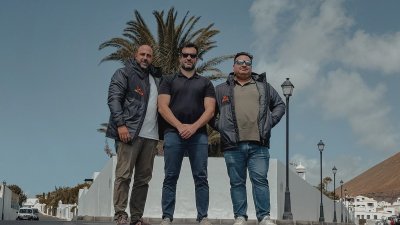
Juan Manuel García is from Madrid and studied audiovisual communication. He arrived six years ago by the hand of his partner, who is from Lanzarote.
Both he and his Lanzarote partner, Francisco Javier Cáceres, who studied tourism, has traditionally earned a living in the world of marketing, purchasing, and communication, especially in the tourism and retail sectors.
However, it has been their passion for technology and photography that made them land in the world of drones and found in Lanzarote the company Skynox Drones SL, which has just won the Sustainable Talent Award from the Chamber of Commerce of Lanzarote and Líneas Romero.
Technological solution to one of Lanzarote's most critical challenges
The awarded project is a technological solution to one of Lanzarote's most critical challenges, water management, as it is capable of detecting water leaks through drones with temperature sensors.
Although the tasks are not yet perfectly differentiated, García is in charge of “the preparation of operations and flight plan” and “Patxi (Francisco Javier Cáceres) is in the analysis analysis and processing part, has more experience in software”.
“Already in the field, Patxi is more focused on the drone and I more focused on the other sensors that complete the data collection such as the hydrometer or the thermocouple for the soil temperature”.
A third partner from Lanzarote, Juan Manuel Rosa, with business studies, and who has recently joined, is focused “on the part of thermography and very related to the construction client and the projects of topography and plot measurement”.
The project arises "at the school gates discussing the island's problems"
García recounts how the project arose: “We were at the school gates discussing the island's problems, and specifically the issue of water, and we started talking about drones. A drone is nothing more than a robot with propellers; what's important are the sensors it carries, its thermographic and flight capacity, sufficient to fly over as much terrain as possible.”
“We assumed the hypothesis that the water was going to be colder than the asphalt, when in the end, in most cases it is the opposite, the ground is colder and what we detect is the hot water underneath,” he shares.
“The viability of the project they have verified with simple civil-use drones with cameras and thermographic sensors with which we have detected leaks under the asphalt” he/she completes.
“Now that we have the methodology, we are experimenting and we have seen a drone that has autonomy for 4 hours compared to 40 minutes, and capacity to carry more than one camera to complete data collection, and in addition to thermography, it can use the multispectral technique (with sensors capable of capturing images in different bands of the electromagnetic spectrum, not only in the visible range) and obtain much more information,” shares García.
Once the hypothesis has been tested and the solution designed, Skynox Drones SL is currently working on scaling the service, that is, “flying further, longer, and with better sensors”.
“We have started in Tahíche, El Golfo and Mozaga”
To finalize the service in Lanzarote, “we have met with different institutions, with all those who have interest and capacity” in this matter, such as the Water Consortium and Líneas Romero Foundation.
Soon they will hold meetings with Cumbre 8 and with the Tourist Centers because “they consider that there could be the possibility of connecting the initiative with the Strategic Transformation Framework (MET)” —the initiative promoted by the Cabildo de Lanzarote through the Centers to redesign the island's development model.
While the contracting method by the administrations is being defined, Skynox Drones SL continues working: “We are mapping Lanzarote area by area to see where there are leaks. We have started in Tahíche, then the area of Golfo and recently by Mozaga”.
“We have detected a significant distribution line with problems that goes from Uga to Montaña Mina. Now we have to specify the exact location, the materials of the line, the depth at which it is buried, the type of soil… There is a lot of information that helps us to be much more efficient”.
“We are advancing in data volume, adding new sensors and methodologies” so that, in addition to detecting leaks, “we can geolocate point by point where the affected pipes are, with one centimeter of error”.
The objective of Skynox Drones SL, which wants to focus on areas with plans to be repaved to find possible leaks sooner, is to develop a tool where they can “have incidents located, categorized by level of severity, with physical documentation and that at a given moment they can put, resolution taken, team assigned, etc”.
“One of our philosophies is ‘Lanzarote First’”
Skynox Drones SL has been contacted by experts from Tenerife and by some water laboratories to potentially do a pilot project in municipalities of the peninsula.
However, García shares: “One of our company philosophies is Lanzarote First. If in a conflict of interest I have to go to a municipality on the peninsula and I have to wait 15 days to do the same in Lanzarote, we will stay in Lanzarote.”
Looking ahead, they are defining the technical profiles they could hire in Lanzarote such as “AI development engineers, agronomists, geologists or surveyors, and also pilots”.
Because Skynox Drones SL, although it has prioritized the water leak project, has other initiatives, for example, in the field of photovoltaic and wind energies, in which they carry out automated inspections of facilities through AI and drones.
In fact, the development in the field of AI is a fundamental matter for Skynox Drones: “with greater volume of AI, greater capacity to diagnose”. And they are evaluating several sources of funding in this field.


Add La Voz de Lanzarote as a preferred Google source.
Stay informed with the latest current news.