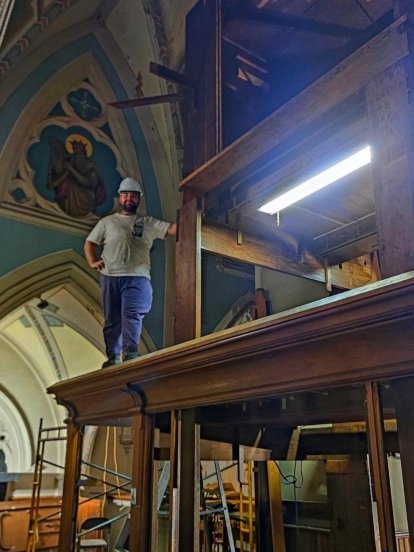
For the upcoming feast of Los Dolores, the hermitage will feature a 19th-century organ that will sound at full capacity, as confirmed by Alejandro Rodríguez, the organist specializing in restoration, who is overseeing its recovery.
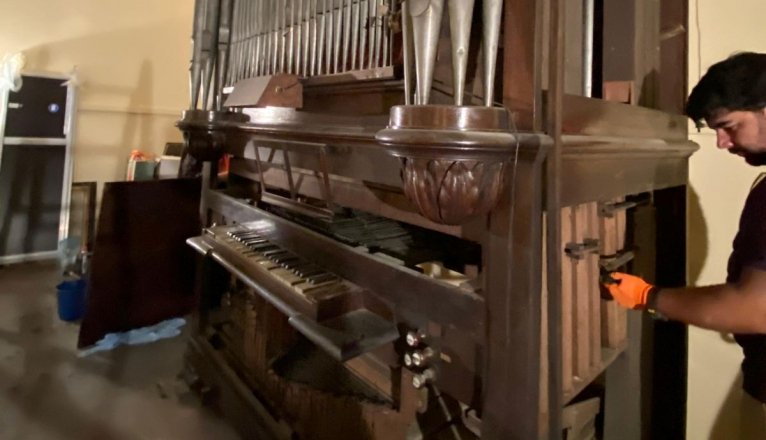
In early November, Rodríguez brought this organ, weighing over a ton, to the Canary Islands in his own van from the south of France, after dismantling it piece by piece.
He is currently restoring it in his workshop in Gran Canaria. Rodríguez studied Marine Sciences and is also a music pedagogue after training at the Higher Conservatory of the Canary Islands. He holds a master's degree in Historical Heritage, is pursuing another in musicology, and is also completing his doctorate at the University of Las Palmas de Gran Canaria in musical organ acoustics.
An instrument he masters as much as an organist, because he plays them, as an organ builder, because he repairs them.
Its profile is unique in the Canary Islands because it can handle all phases. The construction of an organ involves carpenters, construction workers, harmonizers, furriers, pipe makers, and also employees responsible for all the instrument's mechanics.
The organ for the hermitage
The Tinajera parish financed the purchase of the French organ for about 7,000, as well as materials and transportation. "I've donated the hours of work on the restoration," explains the young organ builder.
"Now I'm working on the bellows, and I hope to have the restoration finished by the end of the year. Then I'll go to Lanzarote, they'll start assembling the organ, and then we'll spend several months tuning and harmonizing it to inaugurate it in September."Although the complete restoration and inauguration will be for the Dolores festivities, the organist believes that **it will approximately sound during Holy Week**, even if the harmonization is missing, and compares it to a car: "We can put an engine in it and it works, even if it can't yet reach 80 km/h."
Instruments restored in Lanzarote
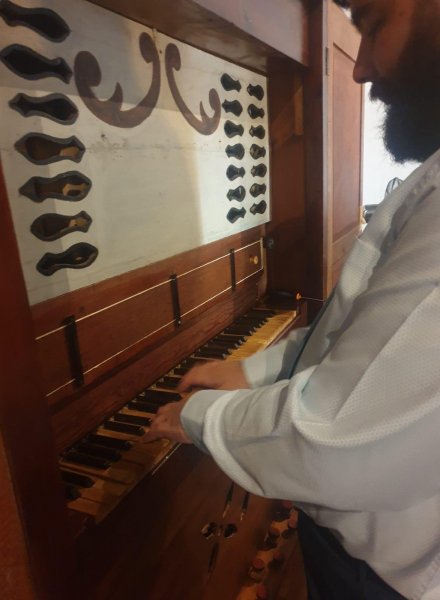
In Lanzarote, Rodríguez first restored the **harmonium of San Roque** in Tinajo with a grant from the Canary Islands Government. "A Parisian instrument, of the Alexandre Pérez brand," which had been unused for decades.
“Then came the restoration of the **organ of San Bartolomé**, funded by the Church, which was a bit of a pilot project,” once its acoustic quality was demonstrated, to decide on the acquisition “of the organ that is currently in the **Cathedral** of Las Palmas de Gran Canaria, because it is by the same builder,” explains the organ restorer.
Rodríguez is also in charge of the **maintenance** of the instruments, which are checked between October and December, and of others, such as the aforementioned one at the Cathedral.His next project in Lanzarote will be the restoration of the organ at San Ginés, for which funding sources are being sought
Rodríguez likes his job and is usually very generous with the instruments from the islands, especially when he can save them from oblivion.
“The Saint Bartholomew organ was delisted, it didn't exist for heritage purposes. The restoration of the Saint Bartholomew organ cost around 4,000 euros; at market prices, it would have cost between 40,000 and 50,000 euros”.
"Whenever I can give something away, I try to, especially here, because in the Canary Islands there isn't much awareness or great interest in restoration yet."
Rodríguez has also restored string instruments like guitars, but as an organist, what he prefers is restoring keyboard instruments, it's what fulfills me the most, and then even inaugurating it with a new musical piece written by him for the occasion.
Restoring instruments as a profession
When asked about how to become an instrument restorer, Rodríguez explains that "there are no specific studies, but you can train in different workshops".
“In my case, I worked in Portugal for a long time and I usually work there in a small workshop dedicated to instrument restoration, especially organs and pipe manufacturing primarily”.
He also trained with stays of several months in workshops in Barcelona, France, Belgium, Germany, and the United States, where I was already working on my own,”
Asked which instruments are most valued once restored. The young organ builder explains that the instruments that increase most in value over time are “string instruments such as the viola, double bass, cello, and above all, the violin”.
For those who want to make a living restoring instruments. Rodríguez explains that "in the Canary Islands there are about five companies, but most of their members, like me, not only restore but are also musicians or teachers, because there isn't always a continuous volume of work".
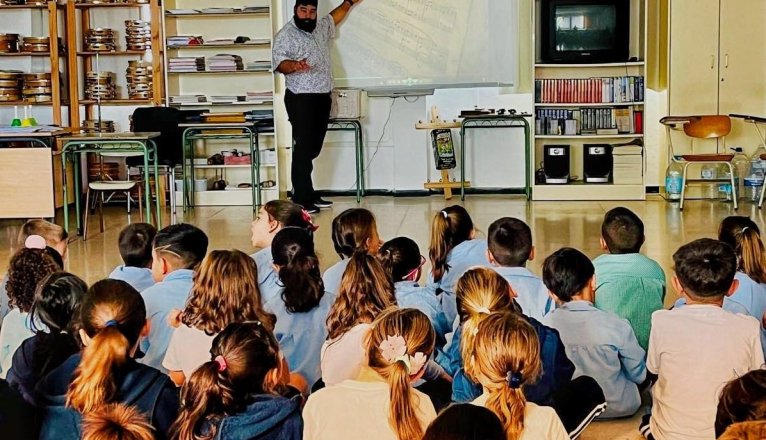
The organ builder from Gran Canaria explains that he makes a living as a freelancer for instrument restoration and as a musician. “I also do educational projects with young people”.
When asked about the place in the world where he has been treated best in economic and professional terms, he doesn't hesitate for a moment: The United States.
"There, for example, I had to dismantle a rather large organ, three times the size of the one in the Tenerife auditorium. It was a five-keyboard organ, weighing between four and five tons. From minute zero, I was appointed head of dismantling services, and **if I wanted 20 workers tomorrow, I had them.** There, money or time are never a problem," he shares."If it was necessary to open a hole in the pillar to remove the organ, it was done," explains Rodríguez. "Here it's unthinkable, to do anything, there's a lot of bureaucracy."

Add La Voz de Lanzarote as a preferred Google source.
Stay informed with the latest current news.