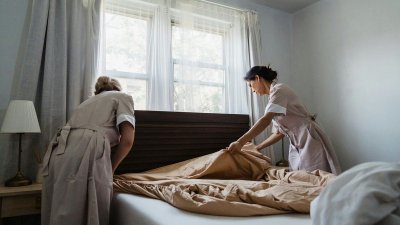
The Government of the Canary Islands has developed the technical guide 'Planning of working time in the housekeeping department', a preventive tool to adapt and apply the study of times to the pace and workload of the professional group of housekeepers.
The guide has been presented by the Minister of Tourism and Employment of the Government of the Canary Islands, Jéssica de León; the General Director of Labor, José Ramón Rodríguez, and the director of the Canary Islands Institute for Occupational Safety (Icasel), Elirerto Galván.
This methodology defines a safe and healthy method based on the analysis of different factors, including, for example, the category of the establishment and the environment where it is located, the dimensions of the rooms, the time of year, whether the linen change system is on demand or planned, the type of client, the equipment of the room, as some represent more work and even the effort required by the professional to clean it.
“This document is the first work of these characteristics in the Canary Islands and it is a very elaborate and rigorous tool”, stressed the Minister of Tourism and Employment, Jéssica de León, who highlighted that «the objective of this type of tool is to continue delving into the prevention of occupational risks, and it is also one more tool that we provide to companies, although they also have the obligation to measure that burden».
The Minister added that «the prevention of occupational risks throughout this year has been a fundamental pillar for the General Directorate of Labor, and during the first quarter of the year we have reduced the incidence rate to 12.5%, so the effort is paying off».
The Minister of Tourism and Employment referred to Icasel, which is celebrating its 25th anniversary, and also valued the work of the labor inspection «since when no one was talking about the prevention of occupational risks for housekeepers in Spain, the Canary Islands in 2006 already established the first methods of prevention of occupational risks for this group».
In addition, she pointed out that during this year the ergonomic and psychosocial studies will be carried out, which will culminate at the end of the year, whose conclusions will allow the development of prevention tools and emphasized that «for the first time the psychosocial risk associated with mental health disorders is evaluated, not only in the housekeeping sector but also in all production sectors».
In 2023, 4,364 work accidents with sick leave were declared in the accommodation services sector, 99.77% of which are minor. “The group of housekeepers is once again the occupation with the highest accident rate, concentrating 38% of the total work accidents, that is, 1,176”, pointed out the General Director of Labor, José Ramón Rodríguez.
For his part, the director of Icasel, Elirerto Galván, explained that «we try to provide a participatory approach, with representation of workers and unions and not only the senior technician of Occupational Risk Prevention and the company», and pointed out that «it is a preventive method, according to the situation of the worker and a process of analysis and improvement of the cleaning procedure».
Before starting the study, he indicated, «an updated evaluation of the ergonomic and psychosocial risks of this work was carried out, while the rooms were evaluated to adapt them to adequate ergonomic conditions with appropriate furniture, which, for example, does not weigh”.
How does this tool work?
The study measures the times used by experienced workers, with cycles of 8,000 rooms made, and supplements such as breaks and pauses are established while the preparation of the cart and common areas is valued. «It is about being as specific as possible to measure exactly the time it takes a trained person and an experienced worker to do their job», clarified the director of Icasel.
This tool, which was presented in detail to employers and unions at the last Technical Hospitality Table, collects the way to analyze the methods and working times of housekeepers through different phases. In the first place, the works council must be consulted, which has the right to issue reports prior to the start of the study.
In a second phase, a joint working group for the application of the methodology is constituted, which will be formed by representatives of the company and the workers. Subsequently, an analysis of the working method must be carried out, which will define a safe and healthy system from a preventive point of view, reflecting the tasks, the way in which they are executed and the equipment used.
Once the work processes have been defined in accordance with the preventive aspects, the measurement procedure is established, which will take into account several aspects: the type of room and cleaning, the working day, the time supplements for breaks, fatigue, personal needs, etc.
Finally, with this study the workload to be carried out, the number of rooms and tasks for each housekeeper will be fixed. Once the method has been applied, it is proposed that a trial period be established to check the operation of the new work system and that the results of this be assessed within the Security and Health Committee of the hotel, or – in the case of companies without a legal obligation to constitute said body – with the prevention delegates or directly with the staff.

Add La Voz de Lanzarote as a preferred Google source.
Stay informed with the latest current news.