
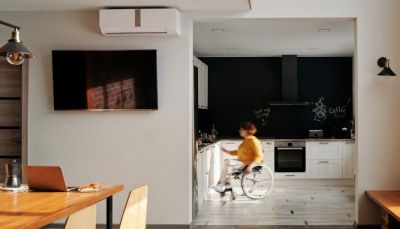
More and more in our society, universal accessibility and design for all are becoming important not only at a public level but also in the family environment. Professionals seek to create spaces that are functional and aesthetically pleasing for all people, taking into account functional diversity. However, in Spain, only 1% of properties meet these standards, which shows that there is plenty of room for improvement.
Experts in the interior design industry are clear about the importance of accessibility from an ethical perspective, but also from a revaluation of the real estate market, according to Alberto Badás, marketing manager at stannah Spain.
Importance of accessible interior design
In a country with an increasing aging population, such as Spain, accessible interior design is gaining importance, as almost 20% of the population is over 65 years of age.
We have asked the specialists at Stannah Spain what the keys would be to creating a welcoming and accessible environment, and they have indicated the five current trends in design for all, which are based on achieving an almost perfect balance between functionality and aesthetics.
Key trends in inclusive design, according to Stannah Spain
- Open concept
Open spaces improve accessibility by eliminating doors between the different rooms of a home, making the rooms more spacious.
In old interior designs, doors and hallways were a real problem for anyone with reduced mobility, not only because of the lack of width, but also because they generated a concept in which passage is always reduced to the same spaces. Converting them into an open concept space favors freedom of movement.
- Stairlifts
One of the most current design trends to eliminate architectural barriers such as stairs is the use of stairlifts.
Their designs, increasingly integrated into the decoration of the home and of reduced and even foldable dimensions, are a plus when integrating them into the daily life of any home. The option of installing single-family elevators of the latest generation, with minimalist designs and that practically go unnoticed occupying a minimum space, is also becoming increasingly popular.
- Lighting
Lighting is increasingly a basic aspect for habitability and interior design. It can make the space seem larger and more welcoming, but also prevent accidents in the home. The introduction of LED lights is of great importance in this, adaptable to different visual needs, and with low energy consumption that allows them to be kept on at night in key points to avoid accidents.
- Multifunctional and flexible spaces
The design of spaces prioritizing mobility and the versatility of the different areas of the house is another key trend when generating interiors that take into account the needs of people with reduced mobility. The use of modular furniture and accessories facilitates the creation of personalized environments adapted to specific needs.
Folding furniture offers greater freedom of movement and helps save space that can be used to move without barriers while not in use.
- Assistive technology
The integration of assistive technologies and home automation in interior design functions as a basic support in the domestic life of people with reduced mobility who no longer have to physically access each device to interact with it. Controlling appliances, heating and lights through mobile applications makes it easier for people with disabilities to use them, even incorporating voice functions.
These trends bring us closer and closer to a design focused on people and their well-being, beyond the traditional aesthetic concept. More and more professionals, such as those at Stannah Spain, are introducing it into their work, ensuring that each project complies with universal accessibility standards to generate an increasingly inclusive world.


