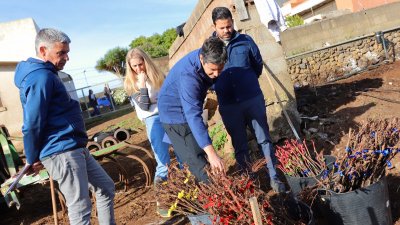
The Canary Executive has launched grapevine pattern trials as part of its strategy for the control and eradication of phylloxera.
The initiative aims to evaluate, under real cultivation conditions, the behavior of different vine rootstocks in combination with varieties adapted to each area, in order to obtain plants more resistant to the insect and contribute, at the same time, to improving the yield and production of the crop under the climatic, edaphological, and biological conditions of the Archipelago.
In Lanzarote, the rehearsals start on May 20 at the Experimental Farm of the Cabildo and at Bodegas el Sitio, in San Bartolomé, according to sources from the Ministry explained to Ekonomus.
They will also be carried out on voluntary farms in Tenerife, La Palma, La Gomera, Gran Canaria and Fuerteventura. This distribution will make it possible to obtain representative information of different edaphoclimatic realities and to transfer useful conclusions to the sector based on the characteristics of each production area.
During the visit, in which he was accompanied by the Deputy Minister of the Primary Sector, Eduardo García Cabello, Quintero explained that “this is the right time to start this project, because it will allow us to advance in the development of a more resistant crop against phylloxera and, furthermore, to respond to other challenges that currently affect the vineyard in the Canary Islands, such as drought episodes, water scarcity, the aging of plant material, and the incidence of diseases and other biological agents”.
In this regard, the counselor recalled that the Canary Islands did not suffer the effects of the plague, which affected a large part of Europe at the end of the 19th century and which forced the generalized use of rootstocks resistant to the insect. “The appearance of phylloxera in the Archipelago last year forces us to anticipate, study all possible alternatives and provide the sector with effective tools to face this problem with guarantees,” he pointed out.
In this regard, Quintero stressed that these trials will allow “to analyze which patterns offer better results in the Canary Islands, both from the point of view of resistance to the insect and its adaptation to the soil, climate, and traditional varieties of our islands”. “It is not only about combating phylloxera, but also about improving the future viability of vine cultivation, making it more resilient and protecting a sector that is an essential part of our economy, landscape, rural environment, and identity,” he added.
This project, approved by the Scientific-Technical Committee established in September as an advisory body for the control and eradication of phylloxera, will focus on analyzing the agronomic performance of different rootstocks as carriers for Canary Islands vine varieties, as well as their adaptation to the different soil and climate conditions existing in the Archipelago.
How does the project work?
The trial design is based on the combination of different patterns with two or three varieties selected in each case by the farmer, considering their experience, the conditions of the area, and the reality of each farm. For this purpose, plots of approximately 2,500 square meters have been selected in which traditional plant material will be grafted onto these rootstocks, with the objective of analyzing their resistance against phylloxera, their behavior against diseases and other biological agents, and their capacity for adaptation to the soil and climate of the Islands.
The Ministry defrays the cost of the actions, assumes the realization of the grafts through specialized personnel and will carry out the technical monitoring throughout the development of the initiative, whose estimated duration is five years, a necessary period to obtain rigorous, consistent and applicable results to the whole sector.
Likewise, economic compensation has been provided for participating farmers, with aid of 4,000 euros during the first year, corresponding to the implementation phase, and an additional 1,000 euros during each of the following four years, intended for the maintenance stage of each trial plot.
Quintero highlighted that these works are part of "a broader line of action that the Government of the Canary Islands has been developing since the detection of phylloxera to guarantee its control, prevent its spread, and move towards its eradication". In this regard, he recalled that the regional Executive has allocated a total investment of 1.1 million euros this year to actions related to the fight against this insect.


Add La Voz de Lanzarote as a preferred Google source.
Stay informed with the latest current news.