
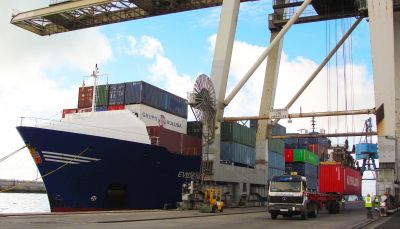
The uncertainty of the war in Ukraine and the increase in restrictions in China to guarantee its zero covid policy have increased the pressures on supply chains, which means that the cost of maritime transport remains at historically high levels.
The Baltic Dry Index, an indicator that measures the evolution of the cost of maritime transport of goods and is based on a basket with freight rates of various categories of cargo ships, closed the week at 2,342 points.
This is 58.4% less than the maximums reached last October, but it is still very high. With the exception of a specific rise in September 2019, it is at its highest level since 2010.
The average of the ten years prior to the pandemic of this indicator is 1,240 points, according to data available on Bloomberg.
The pressures on global supply chains arose after the revival of activity with the relaxation of the restrictions adopted to face the pandemic and triggered maritime transport costs, which, as XTB analyst Joaquín Robles recalls, "is decisive for the evolution of the economic cycle", since 80% of world trade is by sea.
The excessive increase in demand caused enormous pressures on supply chains, which led to problems in ports related to the loading capacity of ships, the lack of containers to transport the goods and the shortage of labor.
At the worst of the post-pandemic bottlenecks, in October last year, the Drewry World Container Index (an indicator based on freight rates for containers on eight trade routes linking Asia with Europe and the USA) marked its all-time high at 10,377 dollars per container.
Since then, its price has moderated, but it has finished the week at 7,578.6 dollars, the same price it registered in June last year, in full ascent with the commercial opening after the pandemic. The cost of the container for the ten years prior to the arrival of the coronavirus was 1,626 dollars.
The chief economist of the Natixis investment bank for Asia Pacific, Alicia García, maintains that the lifting of the confinements in China in recent weeks "should improve the bottlenecks in key commercial ports such as Shanghai".
However, she warns that there is still a "crucial problem", since the border remains closed with quarantines of at least ten days, "which increases the cost of air and sea transport, including the freight train link between China and Europe".
Manufacturers in Europe and the USA depend on supplies from China and other East Asian economies, so, as Robles points out, "recent blockades, price increases, disruptions and delays in container shipping hinder production".
These variables could cut industrial production in the Eurozone and the US by between 3% and 5% and "close to the contraction zone", he adds.
War in Ukraine
In a report this month, the Citi investment bank points out that the war in Ukraine has added new pressures that will cause a greater persistence of tensions, especially if it is prolonged over time.
Russia is one of the main exporters of oil, coal, iron and steel, goods that are sold in global markets, so interruptions in its exports will translate into higher prices.
Last March, Brent touched 140 dollars per barrel, a price not seen since the historical highs of 2008, and natural gas broke all records by reaching 335 euros per MWh.
In addition, Russia and Ukraine are key exporters in a large number of raw materials, such as wheat, processed nickel and fertilizers, wood, steel, titanium, aluminum, coal and gas, goods now stuck in the ports of the Black Sea.
The next months
"The economy at a global level continues to be threatened by the high prices of raw materials and by the problems in supply chains", says Robles, who also indicates that maritime transport continues without being able to cover all the demand, despite the fact that it has moderated with the increase in inflation.
This expert sees a slowdown in transport costs as a possible effect of the lower demand that would be caused by the decline in world economic growth after the interest rate hikes of central banks.
However, he points out that freight prices will remain high until port restrictions and terminal inefficiencies are resolved, so he considers that to return to normality without demand falling "it will be necessary to invest in new infrastructure solutions, loading technology and digitization".


