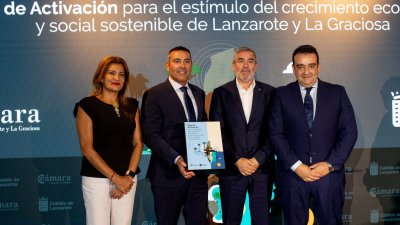
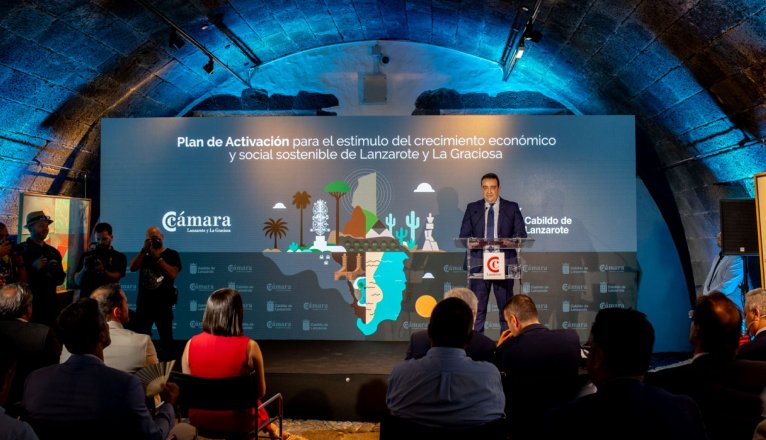
The Castle of San José (MIAC) hosted this Friday the official presentation of the Plan for Economic, Social and Sustainable Activation of Lanzarote and La Graciosa. An ambitious project promoted and executed by the Chamber of Commerce and financed by the Cabildo of Lanzarote, through the Planning and Project Coordination Unit, which aspires to mark a turning point in the island's development model.
The event was attended by the President of the Canary Islands, Fernando Clavijo; the President of the Cabildo of Lanzarote, Oswaldo Betancort; and the President of the Chamber of Commerce of Lanzarote and La Graciosa, José Valle; as well as a wide attendance from the business sector, the island's city councils and representatives of the Spanish Chamber.
With an estimated investment of 646 million euros to be executed in the next ten years, the plan is structured in 138 projects aimed at addressing the main structural challenges of the island. The strategy starts from a collective, transversal and technical vision, the result of a broad process of social and political participation.
The President of the Canary Islands, Fernando Clavijo, stressed that "this Plan is by and for the Canary Islands, because what we are doing today in Lanzarote and La Graciosa is an example of how solutions are built from the local level for all our land," he said. And he added, "a good document is not enough. We need collective commitment. From institutions, from companies, from citizens. Because only in this way will we ensure that each project becomes a reality that improves people's lives," he said.
The President of the Cabildo of Lanzarote, Oswaldo Betancort, stressed that "this plan has been built on a participatory and plural process, listening to citizens, social groups, productive sectors and all political forces represented in the institution. When administrations, companies and society work together, the island gains in employment, gains in economy and, above all, gains in quality of life."
Betancort firmly defended "the model of public-private collaboration" and stressed that "this plan is a strategic alliance with future planning, in which each party contributes the best of itself to guarantee opportunities, well-being and quality of life to the population of Lanzarote and La Graciosa, while preserving the unique identity of our islands."
Roadmap for ten years
The Activation Plan is a real example of public-private collaboration and citizen participation that makes it a national benchmark and an exportable model to other territories. According to José Valle, president of the Chamber of Commerce, "this is a pioneering roadmap, far from political cycles, that will transform the economic and social model of the islands." It is also the only strategic plan of these characteristics in Spain led by a Chamber of Commerce, which guarantees its independence and its orientation to the general interest.
Its governance model guarantees its continuity and has a public monitoring portal where citizens can check its progress in real time, to ensure transparency and co-responsibility.
Strategic axes
The 138 projects are articulated around five major lines of action: Sustainability and environment, with priority actions in water, energy and territory; Economic diversification, strengthening sectors such as excellence tourism, the primary sector, digitization and the blue economy; Well-being and quality of life, with measures to improve housing, culture and public services; Key infrastructures, modernizing health, port and airport networks; Talent and innovation, with programs to attract, train and retain qualified profiles.
Specific initiatives are contemplated in housing, such as the inventory of empty properties, guaranteed rental programs, incentives for rehabilitation and a stricter regulation of vacation rentals. In mobility, a more efficient public transport network, dissuasive parking, intelligent technologies and a safe cycling network are planned, among many other proposals.
The financing will be mixed, with contributions from the Cabildo, city councils, Government of the Canary Islands, State, European and private funds, as well as institutions such as the European Investment Bank. The projects are staggered by urgency, which allows their gradual execution with a minimum annual investment of 16.7 million.
Tourist model
In the tourist field, the plan bets on a quality model, with more conscious visitors and higher average spending, reducing the pressure on natural resources. Synergies are promoted with sectors such as gastronomy, commerce or crafts.
Retain talent
Finally, it seeks that emerging sectors such as renewable energies, digitization or the audiovisual industry gain weight in the island's GDP before 2035. The strategy includes measures to promote startups, connect training with the labor market and generate professional opportunities that prevent the flight of young talent.
"The true value of this plan is its ability to generate consensus and offer a realistic, transformative and permanent roadmap," concluded José Valle

Add La Voz de Lanzarote as a preferred Google source.
Stay informed with the latest current news.