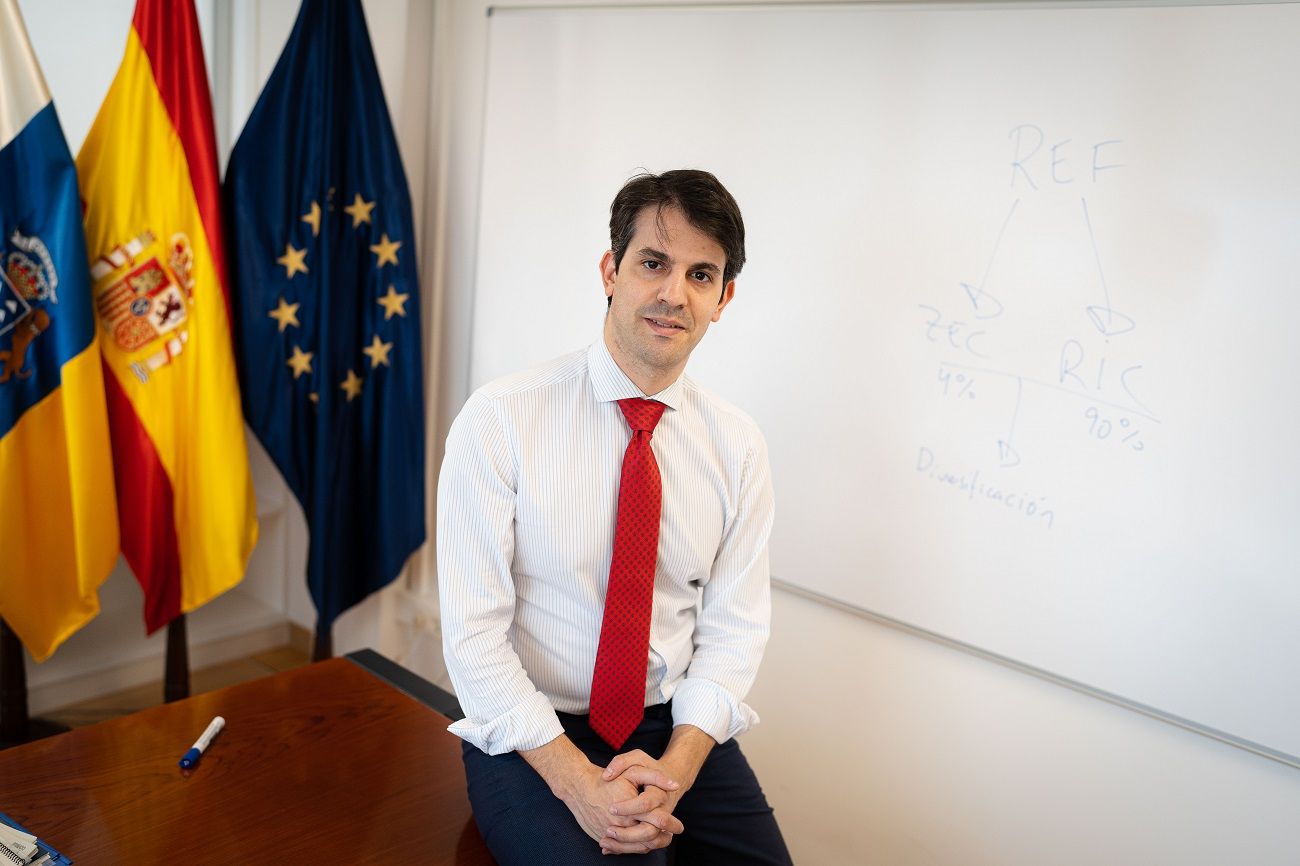
The fight of international organizations against tax havens after the financial crisis and the change of priorities after the pandemic have made the ZEC more competitive and is attracting many more companies in recent years, according to the president of the ZEC Pablo Hernández, in an interview with Ekonomus.
If since 2000, when it was established, until 2014, the ZEC "had generated 4,000 jobs" in the archipelago, in the last six years "it has added 5,000 jobs", so the ZEC expects to exceed 10,000 jobs very soon, says Hernández.
For companies, joining the ZEC means a reduced tax of 4% on corporation tax, if they meet a series of employment and investment conditions. The objective is to attract business projects, excluding the tourism sector, to contribute to diversifying the economy of the Canary Islands.
Subscribe for free to the Ekonomus weekly newsletter clicking here
The ZEC companies of Lanzarote
According to the latest official data published, in Lanzarote there are 42 companies under the ZEC, with an investment of more than 10 million euros and employing 335 people. Among them, companies dedicated to the agri-food sector, renewable energies and technological micro-enterprises predominate.
Among the companies that have joined the ZEC in Lanzarote, “there are companies of Canarian, Spanish and international origin. In the last two years there has been a significant growth of foreign companies, especially micro-enterprise profiles. Recently, a cybersecurity company and another online marketing technology company have joined the ZEC in Lanzarote,” details the president of the ZEC.
United Kingdom, Germany, Italy, France and the Nordic countries are the origin of many of the companies that have joined the ZEC in Lanzarote. They are also the largest issuers of tourists to the islands. “People who come on vacation, to whom someone suddenly tells them about the advantages of the ZEC and decide to move their activity here,” explains Hernández.
But the ZEC also organizes information campaigns in origin where there may be synergies. For example, “in Norway we do a lot of naval, since the Canary Islands have a lot of experience in this sector,” illustrates the president of the ZEC.
They have also recently started promoting the ZEC outside of Europe. In Canada, Japan and the United States. “We have recently done promotion in the United States and we have visited Silicon Valley” to see what can be learned, explains Hernández.
“Lanzarote attracts above all the smaller SMEs dedicated to the technology sector and especially to technology consulting. They are companies linked to digital nomads, who really like the island,” explains Hernández.
The president of the ZEC highlights that Lanzarote has a "triple opportunity" to attract companies. First, “the tax incentives”, second, “the quality of life” and third, that in Lanzarote, “for a company to be able to join the ZEC, it is enough to generate three jobs”, while in Gran Canaria and Tenerife they are obliged to create at least five jobs.
Therefore, “Lanzarote can attract more micro-enterprises of remote workers and freelancers”, he summarizes.
The reasons behind the slow historical takeoff of the ZEC
The problem, according to Hernández, was that "the Canary Islands requested to have a tax haven status at a time when the European Union and the OECD were already immersed in trying to close the existing tax havens."
The president of the ZEC recalls that tax havens were created in the 50s and 60s of the 20th century and are specialists in “artificial companies, of paper, that create employment around advisors, consultants, banks... That was what we asked for here in 92”.
“Then they told us no, that we could have a territory with low taxation, but with substance. The activity had to be effectively developed here, nothing from the financial sector, nothing from financial advisory services, in geographically limited areas, with quite a few limitations. That led to the fact that, when it is finally approved with that model in 2000, "it does not take off because people considered it very restricted".
“In addition, those tax havens continued to exist, I am not going to give any names, but we all know the small countries in the center of Europe. If I had my company in Paris and wanted to expand or move it, I had the option of going to a foreign territory that allowed me to create a paper company and continue operating from Paris and, fictitiously, make the tax authorities believe that I was operating from that other country,” he exemplifies.
After the financial crisis, the arrival of companies accelerates
"As of the Great Recession in 2008, international organizations decide to attack that illegitimate low taxation and achieve it in a certain way. Now, in order to access low taxation in any country, you have to effectively develop the activity in that country,” explains Hernández.
In addition, the European Union and the OECD have been working to end banking secrecy of the territories known as 'non-cooperative jurisdictions'. Currently, most countries exchange information.
“So, under equal conditions, if that person who has their company in Paris has to move to access low taxation, they prefer to do it to the Canary Islands. First, because there is more quality of life, there is a better environment. Second, because it gives more legal certainty, because the ZEC is authorized by the European Commission and that of other countries is not. And third, because our tax rate is lower, in other jurisdictions it is around 10%,” illustrates the president of the ZEC.
Hernández underlines the effect of the pandemic: “people are much more aware of the importance of quality of life. Living in London to earn 5000 euros, paying for an apartment of 3000 and having it be night at three in the afternoon no longer makes sense” for many entrepreneurs.
Companies come to the Canary Islands “looking to pay less taxes, but above all for the quality of life.”
The future of the ZEC
The ZEC could even increase its competitiveness when the 'minimum tax' of 15% is approved worldwide.
That agreement, to which the main Western powers have been joining, seeks to combat large companies that create artificial structures to pay 1% or 1.5% in taxes.
And above all, to combat tax havens, which not only promote tax evasion, but also unfairly compete with territories, such as the Canary Islands, with legitimate and justified special tax regimes, as an outermost region of the Union.
Spain already implemented the 'minimum tax', but excluded the Canary Islands. When it is consolidated worldwide in the coming years, “some companies” under the ZEC “could be affected”, but in reality, “much less” than those that operate in “the territories that compete with the Canary Islands”, explains Hernández.
It will also be “an opportunity”, clarifies the president of the ZEC, because several “exemptions from the 'minimum tax' are completely aligned with the ZEC”.


Add La Voz de Lanzarote as a preferred Google source.
Stay informed with the latest current news.