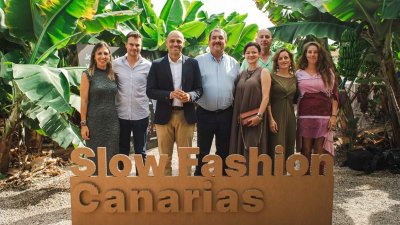
The Sustainable Fashion Days, organized by the Government of the Canary Islands through Proexca and in collaboration with the Enterprise Europe Network (EEN) Canary Islands and the Island Councils, were held this Thursday in Arucas. Under the slogan "A journey towards conscious fashion", it brought together prominent professionals from the fashion industry, both regional, national and international, with the aim of promoting and making visible sustainable practices in textile design and production.
"This meeting represents a significant step in the archipelago's strategy to strengthen its competitiveness in the textile sector, always within a framework of sustainability and respect for the environment," said the Deputy Minister of the Presidency of the Government of the Canary Islands and president of Proexca, Alfonso Cabello. He was joined by the Councilor of the Cabildo of Lanzarote, Miguel Ángel Jiménez.
The initiative was well received by the European Commission and by all the experts who participated in the event. The speakers included Emmanuelle Maire, Head of the "Circular Economy, Sustainable Consumption and Production" Unit of D.G of the Environment of the European Commission, and Mikael Garellick, of the D.G of Growth of the European Commission. In this sense, the commitment of the Canary Islands to an economic model that is more respectful of the environment, aligned with European strategies on sustainability and circularity, was reinforced.
In addition, the "Slow Fashion Canarias" campaign was presented within the framework of the event, an initiative developed by the Government of the Canary Islands with the fashion programs of the island councils, whose objective is to promote the promotion of artisanal work and the commercialization of local sustainable fashion. This project seeks to revalue the know-how of Canarian artisans and designers, placing tradition and sustainability at the center of the creative and productive proposal.
In this sense, Proexca will launch through this project specialized consultancies that allow brands to evaluate the environmental impact of their production processes as well as obtain European certifications in terms of sustainability, thus guaranteeing that their products meet the highest standards in the fight against climate change and in the promotion of responsible practices.
Sustainable fashion made in Lanzarote
Macaronesia, inspired by the nature of Lanzarote, used recycled polyesters in its new collection, while Daria Bae focused on the durability and resistance of the fabrics, with a clear focus on the circular economy and on-demand production to minimize waste of resources. Creativity and craftsmanship also played a key role. Pendientera, with an aesthetic based on surrealism, used ecologically certified materials such as fabrics with the OEKO-TEX seal, as well as biodegradable inks, thus creating a proposal that fuses fashion and art.
Migongo was inspired by the landscapes of the Canary Islands to develop a proposal in which it has used fabrics from other collections as raw material, thus promoting waste reduction.
The purest craftsmanship was also present through brands such as María Hurtado, who showed unique pieces made by hand using traditional techniques such as handmade felt, using materials such as wool and silk. Ángel Cabrera, from Lanzarote, presented a collection of silk accessories dyed manually with natural dyes and inspired by the cultural heritage of the island.
Oswaldo Machín closed the show with a proposal that stood out for its elegance and sophistication. Inspired by a current and empowered woman, the designer changed artisanal finishes with traditional patterns, re-attempting classic shapes and giving them a contemporary, chic and refined touch.
Other outstanding proposals in the archipelago
Accessories have played a fundamental role in this action, as well as jewelry elements. The firm Alma&Canaria is characterized by developing a sustainable and artisanal design and production policy, creating unique bags through the use of recycled cotton and polyester, demonstrating through avant-garde designs that the traditional can coexist in perfect harmony with trends.
Similarly, Angie Vázquez, has specialized in the design and artisanal production of dynamic and functional bags created through the use of animal leather from Spanish tanneries that have the Leather Working Group environmental certification seal. Maru La Palma and Ban are firms with a marked artisanal character. The first of them includes the design and manufacture of exclusive bags created through the use of fabrics that have OEKO-TEX certification as well as through the use of remnants from waste from other collections, with geometry and different prints predominating in their designs. Ban, on the other hand, specializes in the creation of belts, footwear and handmade leather bags of the highest quality.
Mare Far Niente surprised with a swimwear fashion proposal in which it has used, as raw material, recycled polyesters from Seaqual and natural banana fibers, thus underlining its commitment to the circular economy. For its part, Waiola combined the exclusivity of its prints, developed with recycled materials and through sustainable techniques such as the use of water-based inks, with a dynamic pattern and in which comfort prevails.
In the field of textile innovation, Nathalie Leturcq presented a collection dyed with natural pigments extracted from cochineal and chlorophyll, accompanied by handmade espadrilles made using banana fibers. Gallobuey took innovation to another level by integrating 3D printing with ecological materials such as biodegradable PLA, standing out for its ability to fuse technology and sustainability in its creations.
Among the participating jewelry firms we find Nerea G Murillo, a Tenerife firm that plays with textures and different finishes and in which CSR is within the basic principles of the brand's actions. Its production is based on manufacturing through the use of noble materials such as silver and gold, coming only from the regeneration of resources. Sara Luis, on the other hand, uses materials such as copper, silver or brass for the creation of her pieces, characterized by their organic shapes and by the reuse of materials. With an inspiration based on nature, she merges her message with claims, memories and feelings, building unique pieces that become small sculptures with a story behind them.


Add La Voz de Lanzarote as a preferred Google source.
Stay informed with the latest current news.