The Ministry of Ecological Transition and Energy of the Government of the Canary Islands, led by Mariano H. Zapata, through the FEDER 2021-2027 program, is working on seed-producing orchards of native species.
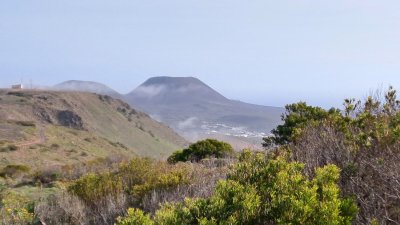
Specifically, this work has been carried out since the end of 2020 on the summit of Famara, as well as in the military facilities of the Air Surveillance Squadron in Peñas del Chache (EVA-22), as the project “Optimization of habitat restoration work carried out on the summit of Famara, Lanzarote.”
Some of these plants are included in the Canary Islands Catalog of Protected Species, such as the Famara bindweed (Convolvulus lopezsocasi), the pinillo (Plantago famarae), the Bourgeau everlasting flower (Limonium bourgeaui), or the hawthorn pear tree (Gymnosporia cryptopetala) among others.
The counselor detailed the good results of this project, explaining that, “we have managed to produce thousands of seeds of 27 native species from the island of Lanzarote, which have become reservoirs of nature, by not allowing the free entry of people and animals, thus facilitating the relocation of new plants in the most degraded areas of the summit, thus ensuring its continuity.”
Specifically, he highlighted the case of guaidil seeds (Convolvulus floridus), an abundant shrub in the western islands but scarce on the island, with only a few natural specimens, stationed on the inaccessible cliffs of the Famara cliff.
More than 10,000 seeds
“In 2021, the Ministry carried out vertical work to collect its seeds, having to carry out complex descent work on the walls of the cliff on different dates, obtaining only 153 seeds.” However, according to what he pointed out, “thanks to these orchards, only during the year 2024 we have managed to produce more than 10,000 seeds, a milestone in the conservation of this plant species,” he assured.
He also recalled that the plant biodiversity of the Canary archipelago faces important challenges in the coming years that require the adoption of new strategies for its conservation, since prolonged droughts as a result of the increase in temperature and the decrease in rainfall are leading many species of the flora of the Canary Islands to a critical situation.”
In particular, “those that have suffered the most from this impact are those that already had their populations reduced by the effect of herbivory, and of which only a few specimens survive in cliff areas that are difficult to access.”
“With the arrival of climate change the situation has worsened,” explained the counselor, assuring that this phenomenon also affects plants, “which are seeing their reproductive cycles altered, as spring is brought forward, and flowering no longer responds to a temporal regularity, so it is not possible to plan an exact date to collect seeds for each species,” stating that the best solution is “the creation of these producing orchards.”
In addition to EVA-22, there is another orchard of native species producers from the island of Lanzarote at the Teguise Secondary Education Institute, where teachers and students from different Vocational Training modules manage, produce, maintain and care for mother plants to contribute to restoring the degraded habitat of the summit, an initiative for which they have been finalists in the XVII edition of the National Learning and Service Awards, and which is called “Planting the future in Famara.”


Add La Voz de Lanzarote as a preferred Google source.
Stay informed with the latest current news.