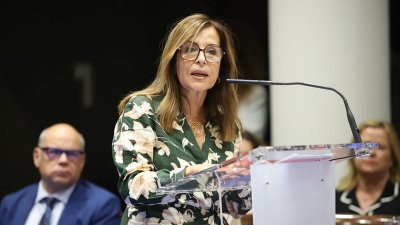
Invisible poverty, which is suffered by poor workers and retirees with low pensions, "does a lot of damage" in the Canary Islands, where poverty rates are also high, the Deputy of the Common, Dolores Padrón, stressed this Thursday.
During her speech on the second day of the annual seminar of the Spanish delegation of the European Network to Fight Poverty, the Deputy of the Common has advocated for an alliance between public administrations, civil society and non-governmental organizations (NGOs) to fight against poverty and social exclusion.
Before speaking at the seminar, Dolores Padrón indicated that the work done by NGOs complements the administrations, which sometimes mistreat citizens, she added, to give as an example that if you have to wait four years to receive a disability certificate for a child, they will not be able to access benefits during that time.
The Deputy of the Common recalled that invisible poverty includes those who have income but are in conditions of vulnerability due to precarious access to basic rights such as education, health or housing.
She insisted on demanding a change in the design of policies to fight poverty and social exclusion that involve transversality, integrality and agreement, with the agreement of all public administrations at their various levels, and that propose a lasting and stable structural shift.
Padrón emphasized that child poverty in the Canary Islands is very high, due in part to the lack of adequate infrastructure and a less developed family support system.
And she recalled that communities such as the Basque Country and Navarra have significantly lower poverty rates due to more robust social welfare policies and economies less dependent on tourism.
The Deputy of the Common also spoke about migration, and stated that non-governmental organizations collaborate fundamentally in the fight against poverty and support for the most disadvantaged sectors in the Canary Islands, Spain and Europe.
These organizations, she continued, act as a complementary pillar to government policies, focusing on direct aid, the promotion of rights and the creation of support networks that allow improving the living conditions of people in situations of social exclusion.



Add La Voz de Lanzarote as a preferred Google source.
Stay informed with the latest current news.