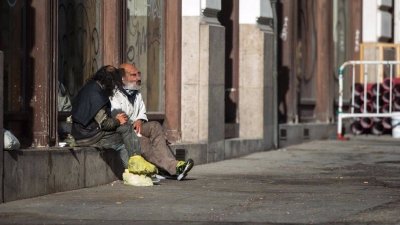
The percentage of the population at risk of poverty or social exclusion (the so-called AROPE rate) in the Canary Islands decreased in 2023 by 2.4 points to stand at 33.8% of the total population. However, it is the fourth highest rate in the country, after Ceuta (41.8%), Andalusia (37.5%) and Melilla (36.7%).
If we only consider the poverty rate, the Canary Islands, with 26.1%, is the third autonomous community with the worst data, only surpassed by Andalusia (30.5%) and Extremadura (27.6%), according to the Living Conditions Survey published this Monday by the National Institute of Statistics (INE).
Meanwhile, regarding the difficulties in making ends meet, the Canary Islands is the third autonomous community in the country with the highest percentage of people who reached the end of the month "with great difficulty" last year.
The percentage of the Canarian population with severe material and social deprivation rises to 11%, only behind Ceuta (19.1%), and Andalusia (12.6%). While it is the third in low work intensity with 14.3%, behind Melilla (20.3%) and Ceuta (17.3%).
At the national level, the percentage of the population at risk of poverty or social exclusion increased by half a point last year to 26.5% while the population with "severe material and social deprivation" climbed to 9%, the highest rate since 2015.
Two of the three components of the AROPE rate improved: the risk of relative poverty - an indicator that reflects how many people have low incomes in relation to the population as a whole - which fell from 20.4 to 20.2%; and the percentage of the population with low intensity in employment (with little activity), which went from 8.7 to 8.4%.
But the third component of the rate worsened: the percentage of the population with severe material and social deprivation rose from 7.7 to 9%. This concept analyzes factors such as not being able to afford to go on vacation at least once a year; eating meat, chicken or fish every two days; or keeping the house at an adequate temperature.
Households with economic difficulties
According to this survey, 9.3% of the population stated that they reached the end of the month with "great difficulty" in 2023 (0.6 points more than in the previous year).
When analyzing the factors that determine "severe material and social deprivation", it is highlighted that 37.1% of households do not have the capacity to face unforeseen expenses (compared to 35.5% in 2022) or that 33.1% could not afford to go on vacation outside the home for at least one week a year (0.4 points less than the previous year).
Almost 30% cannot replace damaged or old furniture; 20.7% cannot keep the house at an adequate temperature; and 13.6% have had delays in paying expenses related to their home or in installment purchases.
Under 16s, the highest risk of poverty and exclusion
The risk of poverty and social exclusion especially affects children under 16 years of age. 34.3% of that group meets at least one of the three criteria of the AROPE rate (2.1 points more than in 2022).
The rate also rose 0.4 points in the group of 16 to 64 years (up to 26.4%) and, on the contrary, fell 0.4 points in the group of 65 years and over (20.9%).
According to the INE, in 2023 - with income data from 2022 - 1.7% of the population was at the same time at risk of poverty, with severe material and social deprivation and with low work intensity.


Add La Voz de Lanzarote as a preferred Google source.
Stay informed with the latest current news.