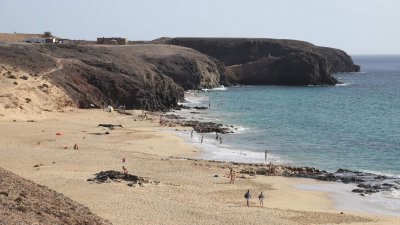
The Autonomous Community of the Canary Islands will present this week before the Constitutional Court (TC) the appeal against the Ministry of Ecological Transition to claim full powers in matters of Coasts, as announced this Monday by the Minister of Public Works, Pablo Rodríguez, who has expressed optimism that they will be proven right.
The Minister has reported this decision at the press conference after the Governing Council, which has agreed to file the appeal to ask the high court to rule against the State and recognize the autonomous community's control over the management of its coastline granted by article 157 of the Statute of Autonomy.
In relation to the appeal that will be filed in the coming days before the high court, he recalled that it is requested "the annulment of the act vitiated by incompetence, that is, the Resolution of the Minister for Ecological Transition and the Demographic Challenge dated February 27, 2024, which declares - among other things - the expiration of the concession granted by Ministerial Order of July 8, 2003" to the Hotel Oliva Beach in Fuerteventura.
The legal services of the regional Executive defend that it corresponds to the Canary Islands, based on article 157 of its Statute, "the exclusive competence of coastal planning", which includes "the granting of authorizations and concessions on the maritime public domain, without differences according to the type of concessions as the State intends".
In fact, the appeal that the autonomous community will raise to the TC argues that, since the renewal of the Canarian Magna Carta in November 2018, the Spanish Government only has powers to "establish the legal regime of the public domain (public property)".
Rodríguez has expressed his conviction that the Constitutional Court will side with the autonomous community because "the legal recognition as exclusively responsible for this matter is already included in Organic Law 1/2018, so there is no discussion or dispute before this fact".
In this sense, the Minister explained that the subsequent Royal Decree 713/2022 focuses on the transfer of services and functions "insufficient" in relation to the powers transferred to the Canary Islands in this area of coastal management, so they request its revision.
He recalled that there are several TC rulings that support the legal interpretation that the autonomous community defends regarding its full powers over the coast.
In addition to a ruling on the scope of powers of Catalonia, the Minister has considered "very important" the Constitutional Court's ruling on the Galician Coasts Law, a regulation similar to the one that the Canary Islands plans to approve in the coming months.
Specifically, the Constitutional Court's ruling after the appeal filed by the State against the law on planning and integrated management of the Galician coast argues that "the executive functions related to the management of titles of use and occupation of the maritime-terrestrial public domain are not part of the state powers as they fit into the competence of coastal planning".
Rodríguez has reiterated that, despite the filing of this appeal before the TC, the Canary Islands will remain open to dialogue to try to resolve this issue through an extrajudicial channel, although, according to the Minister, "the Government of Spain has no intention of effectively transferring the powers", as happens with other autonomous regions, while indicating that "this resistance comes from the structure of the Ministry itself".



Add La Voz de Lanzarote as a preferred Google source.
Stay informed with the latest current news.