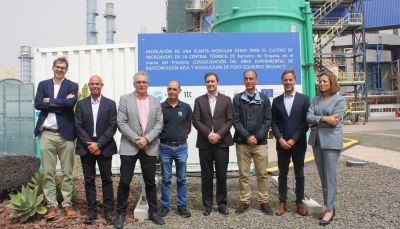
The Technological Institute of the Canary Islands (ITC) and the company Endesa will explore the potential of microalgae as collectors of CO2 from the combustion gases of the thermal power plant located in San Bartolomé de Tirajana (Gran Canaria), and will study these marine plant organisms for biotechnological use.
In a statement, the Government of the Canary Islands has reported on the presentation this Wednesday of this ITC and Endesa project.
The note explains that these aquatic unicellular organisms require sunlight as an energy source and CO2 as a carbon source to feed, generating oxygen during the metabolic process of photosynthesis.
And it has added that getting the microalgae to capture the carbon dioxide from the combustion gases from the industrial process means avoiding its emission into the atmosphere and substantially reducing the cost of the cultivation process, since the extra contribution of CO2 would represent a substantial economic and environmental cost.
The microalgae pilot plant located in the Endesa thermal power plant has a laboratory unit for monitoring crops and analyzing the biochemical composition of the biomass, and two greenhouses that house different microalgae cultivation systems.
The tests that will be carried out will evaluate the technical feasibility of using CO2 from the thermal power plant for microalgae cultivation.
The Director of Generation of Endesa in Gran Canaria, Luis Varela, explained that this collaboration project, signed with the ITC, the ULPGC and the Canary Islands Government is "unique as a response to the complexity of capturing CO2".
"From Endesa we have gladly given the land, the gases from the plant and the facilities. Our gas emissions already come with a certain filtering, the only thing pending was the capture of carbon dioxide, which is exactly what we are going to do with the participation in this project. We have decarbonization in our present and future plans and this pioneering project is an excellent opportunity for it," he added.
According to the statement, the Deputy Minister of Universities and Research of the Government of the Canary Islands, Ciro Gutiérrez, this project "demonstrates the important role played by knowledge centers as a lever for diversification towards green economies, opening the way to new productive sectors, where the Canary Islands has competitive advantages for its development".
The installation of this experimental aquaculture plant is part of the actions executed by the ITC with the BLUEACT project, an initiative fully financed by the FEDER Canary Islands 2014-2020 Operational Program through a direct subsidy charged to the REACT-EU Fund.
Canary Islands investigates the potential of microalgae to capture carbon dioxide
The objective is for the microalgae to capture the carbon dioxide from the combustion gases from the industrial process and prevent its emission into the atmosphere
April 11 2024 (10:24 WEST)