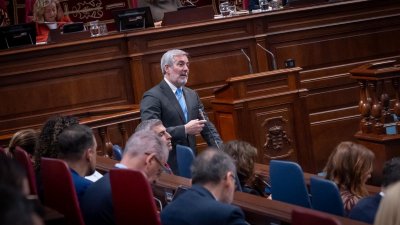
The president of the Canary Islands, Fernando Clavijo, has insisted in Parliament, that the State modify the spending rule and increase the borrowing capacity, from 10.8% to 13%, to be able to design an investment plan of 1.650 million euros to face the long-term consequences of the Iran war.
The president highlighted that “the measures we can implement from public administrations will not be able to absorb the negative impact of the rise in fuels, so we will have to increase our room for maneuver, and be able to establish priorities especially aimed at the most vulnerable people, together with the island councils and city councils”.
In this regard, he referred to the step taken by approving the Decree-Law of initial measures approved by the executive a few weeks ago, “which came to recompose the State's initial one, and in which they had forgotten to take into account the Canarian singularities at the time of its elaboration”.
In the face of opposition criticism, Clavijo recalled that it was the Canary Islands and Euskadi who first proposed a Conference of Presidents to address this matter, which was rejected by Minister Ángel Víctor Torres, and in the face of Moncloa's ‘oversight’ “we were able to negotiate a compensation so that the measures would not be discriminatory with the Canary Islands”.
In any case, the president recalled the retroactive nature of them to the date of the start of the war and that they are extendable if, from June 30, the conflict continues.
The head of the regional executive wanted to highlight that “as an Autonomous Community and with the advice of employers and unions, we have done what our competencies allow us and to influence those aspects in which we could intervene to contain the rise in prices, aid to the self-employed, measures for the primary and industrial sector to compensate for foreseeable losses, and to return the 99% of fuel tax to transporters”.
For Clavijo “are not enough, but neither are those approved by the rest of the Autonomous Communities, the State or other states of the European Union”, and he wanted to highlight the work that the Canary Islands has been carrying out in this Legislature in defense of social services.
Actions already contemplated in the budget, which of 12.4 billion euros, 8.1 billion are allocated to health, education, social welfare and housing. It is 65.5% of the budget and 490 million more than the previous year.


Add La Voz de Lanzarote as a preferred Google source.
Stay informed with the latest current news.