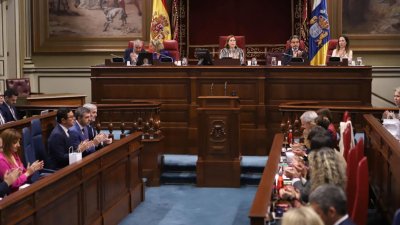
The leaders of CCOO and UGT in the Canary Islands demanded this Thursday in Parliament a fair distribution of wealth and wage increases against the advance of poverty and inflation, in an appearance in which they warned that in the workplace "there is more discontent than ever" and in which they denounced that "the Canary Islands is a factory of poor workers".
For three years, the Canary Islands has led GDP growth in Spain, but wages are the lowest, poverty affects 37% of the population, and purchasing power decreases, they denounced in a parliamentary commission.
And while the collective agreements agreed upon at the end of the pandemic, agreed upon then with labor and social sacrifices so that companies could survive, remain in place due to the employers' refusal to sit down and negotiate.
Inocencio González, general secretary of CCOO of the Canary Islands, Manuel Navarro, general secretary of UGT of the Canary Islands, and Borja Suárez Sánchez, general secretary of the Federation of Services of CCOO Canarias, were very upset with the attempts of the employers to divert the social debate towards issues such as productivity or absenteeism, when the essential issue is low wages.
"We are at a crossroads, if we do not arbitrate formulas so that the wealth that is generated is distributed, so that poverty and social exclusion decrease, we will have to face important mobilizations in a short time, because there is discontent like never before," warned Inocencio González.
For the leader of CCOO, companies have "a lot of room for maneuver to improve" and "this is the moment" to do so through collective agreements and the opening of an interprofessional agreement, a process to which the employers must attend "with will, not just to warm the chair," he said.
Inocencio González urged the Government of the Canary Islands to get involved and encourage a collective bargaining process to improve wages, because in the Canary Islands "unacceptable poverty rates" are being reached, which are "the embryo" of social mobilizations that there is still time to stop, the unionist stressed.
Borja Suárez stressed the importance of the Government of the Canary Islands obliging employers to open collective bargaining to negotiate wage increases, because the executive cannot mediate or arbitrate in the social dialogue if it does not open the game first.
Manuel Navarro, from UGT, rejected the collateral debates on productivity, training or absenteeism that the employers want to open, sometimes whitewashed by the Canarian Government, an excuse not to address the increase in wages and the negotiation of working conditions.
In the Canary Islands there are 167,000 unemployed at a time of great economic growth and many people leave the region due to low wages, not due to lack of training, but because "people want to work to live," said Borja Suárez.
The unionists were particularly upset with the employers' complaints about absenteeism, assimilating medical leave and workers' rights to unjustified absences from the workplace, which are minimal, around 2%.
"Those who are on leave are because they are exhausted from working," because the working conditions that were agreed upon at the end of the pandemic are not being negotiated, when society and workers did their part for the continuity of companies threatened with closure, he stressed.
The general secretary of UGT of the Canary Islands, Manuel Navarro, accused the employers of calling workers "lazy" and of blaming the health services for giving unfounded leave, when it is the companies that do not want to negotiate on prevention, working conditions or occupational health.
When they talk about low productivity, they never talk about the lack of investment in R&D, the low level of training of many entrepreneurs, their poor business culture, their poor allocation of resources, their low investment in technology or the business minifundismo, "that is not talked about," Navarro denounced.
The leader of UGT highlighted that, according to data from the 2022 income tax returns, in the Canary Islands 40% of workers earn less than 14,000 euros per year, with an average of 6,975 euros, and 67% are below 21,000 euros, with an average of 11,189.
"Low wages are the problem," most families have a worrying economic situation and poverty affects 37% of the population while there is "a concentration of wealth that we do not know," said the UGT leader.
He related this general social unrest to the protests of April 20, under which lies precisely the unfair distribution of wealth generated by the archipelago's economy and the fall in purchasing power with stagnant wages.
"The Canary Islands is a factory of poor workers," Navarro sentenced.
And he said to the parliamentary representatives: "Do not be accomplices in the distribution of poverty, but in the distribution of wealth."


Add La Voz de Lanzarote as a preferred Google source.
Stay informed with the latest current news.