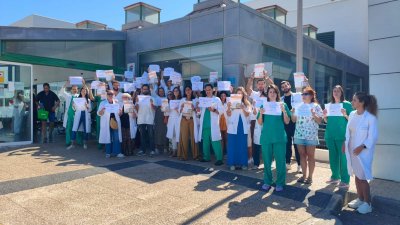
Doctors from all over Spain are called this Monday to their fourth weekly strike of the year due to the lack of progress with the Ministry of Health, which accuses the convening unions of aligning with the right to perpetuate the conflict in pursuit of goals other than improving the conditions of the collective.
The new strike of white coats begins this Monday with hardly any changes compared to the previous one, held in the last week of April, with the conflict at a standstill and the strike committee demanding that the President of the Government, Pedro Sánchez, intervene to resolve it, a request to which the PP and PNV joined.
From Health, its head, Mónica García, defends that the framework statute that doctors criticize improves their conditions, for example, by reducing on-call shifts from 24 to 17 hours, with days off before and after, or establishing maximum weekly working hours of 45 hours compared to the 48 hours set by European legislation.
This is stated in the agreement reached after more than three years of negotiation with the unions of the framework statute table -CCOO, UGT, CSIF, Satse-FSES and Cig Saúde-, organizations that agree that the vast majority of medical demands are already in that document.
Others, such as the price of on-call shifts, the 35-hour working week, or retirement, are either not the responsibility of the Ministry or do not fit within a law like the framework statute.
But the unions of the strike committee -Spanish Confederation of Medical Unions (CESM), Andalusian Medical Union (SMA), Metges de Catalunya (MC), Association of Doctors and Senior Graduates of Madrid (Amyts), Basque Medical Union (SME) and the Union of Independent Galician Graduates (O’MEGA)- insist on demanding their own statute.
A demand that, for now, is only supported by Vox, and on opening an exclusive negotiation channel with Health outside the table organizations.
Throughout multiple formal and informal meetings held in recent months, Health has tried to find solutions by proposing mediation from patient associations or the Medical Profession Forum, to which the strikers flatly refused.
It also proposed the creation of specific negotiation tables within the communities, but this was also rejected.
A conflict "instrumentalized"
It is for all these reasons that García believes that, after all the attempts to resolve the situation, and after more than one sign that it was going to be so, the committee is interested in perpetuating it because it is being used "instrumentally" by right-wing parties, especially the PP, to destabilize the Government.
As things stand, doctors will return to the streets either by supporting the state strike or the regional one that the respective regional union delegations have programmed in parallel. The turnout for the previous ones was similar, with figures ranging between 5 and 20%, according to the regional health departments, and raised to 60% by the unions.
Several regional strikes, such as the one in Galicia, have been suspended after agreements were reached between the regional medical unions and their respective regional health departments on matters within the communities' jurisdiction, such as remuneration.
Meanwhile, in Madrid, Amyts has maintained it after a "short and disappointing" meeting with the regional health minister, and CESM has done the same in Aragón and Comunidad Valenciana.
All in all, from tomorrow until Friday, protests will take place throughout Spain, with Wednesday the 20th as the central day, with several demonstrations scheduled, such as in Bilbao, Vigo or Valencia; and different gatherings such as the one that will be held in front of the Ministry.
Add La Voz de Lanzarote as a preferred Google source.
Stay informed with the latest current news.