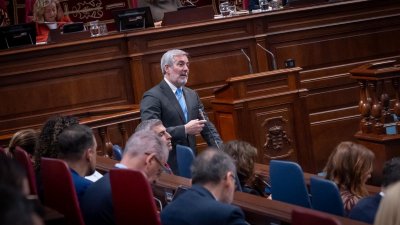
The Canary Islands president, Fernando Clavijo, has stated this Monday that this archipelago, as an Atlantic border, is concerned about the "regression" in terms of respect for human rights into which Europe may fall with the entry into force, in June, of its new Pact on Migration and Asylum.
This was stated when inaugurating some conferences held at Casa África in which representatives of ACNUR, the Consejo Europeo de Refugiados, the Policía Nacional and social organizations such as CEAR and Oxfam have debated about the repercussions that the entry into force, on June 12, of the European Pact on Migration and Asylum, which reinforces the principle of containment at the border, may have for the Canary Islands.
"The Government of Canarias is concerned because there has been a total absence of debate and prior coordination before the application of this pact and its regulation" of which "we do not expect a more human vision and of respect for human rights", Clavijo has referred.
How to give a guaranteeing response of human rights?
Given this new regulatory context, the Canarian administration and its civil and social agents have tried to foresee in this forum how the real managers of this social phenomenon, migration, will have to coordinate from now on, to offer "a much more guaranteeing response" in relation to the respect for human rights and the legal certainty with which these people must be attended to, despite the "unknowns" that persist regarding the materialization of this pact.
Some doubts that the Canarian president will convey to the Government of Spain and to the European Commission on an upcoming trip he will make to Brussels, as he has announced during these conferences.
The first of them is whether Canarias, as a border territory that it is of the EU and a destination to which they arrive in dinghies and cayucos that embark on the deadliest maritime route in search of a better life, is going to host "those black holes of human rights" that this pact foresees, that is to say, the detention centers where migrants can remain up to six months, since that is the maximum period for the screenings to which they must be subjected upon their arrival.
"Are we going to talk about rich Europe that pays not to have migrants on its streets and about poor Europe that has to sustain them?, it has been asked in allusion to the possibility that this new regulation increases the migratory pressure that Canarias will continue to bear, given the political conflict, the climate crisis and the famine that persists in the Sahel and the possibility that the UE reduces in its new budget, as EEUU has done, the funds it allocates to international cooperation."
Above the "xenophobic and fascist policy of some Spanish political groups", the Canarian Government would have "loved" to be able to debate about these unknowns "in the sectoral conference that has not been held for more than a year", considering that "it would have been opportune to open the debate to all autonomous communities", Clavijo has stated.
Besides thanking all public agents and NGOs involved in the Canary Islands in the management of the migratory phenomenon and who attend in the most dignified way to the children who arrive alone, Clavijo has expressed confidence that the upcoming visit to Gran Canaria and Tenerife by Pope Leo XIV "will serve to launch a message of civility, morality and respect for human rights, as the Canarian people have known how to do throughout all these years in which they have been aware that they are people, like" the compatriots "who had to emigrate seeking a better future".
In any case, Clavijo has expressed his fear regarding that the entry into force of the new migratory pact could mean "a before and an after for that European project that emerged from the Second World War, precisely so that there would not be wars and misery again" and so that "human rights would be respected", something that "from the Canary Islands will be tried to avoid".
Black holes of human rights
In line with Clavijo, the general director of Casa África, José Segura, has agreed that the new scenario determined by the decisions that have been taken in recent days in Brussels and Madrid "will mark the future of this Atlantic border and that of migratory management throughout the European Union".
"Europe is in a process of unprecedented hardening of its migratory policy and the new return regulation is a rule that entails, without a doubt, a restrictive turn in the application of the European migration pact", he/she/it has stressed.
The most "alarming" thing about this measure is, in their opinion, "the creation of the so-called 'return hubs' or deportation centers in third countries", which will allow "that people who do not have permission to remain on European soil, including families with minors, will be able to be transferred to infrastructures located in countries with which the EU does not even have to have any kind of ties", they asserted.
A model of "outsourcing that seeks to accelerate expulsions given a current return rate that barely reaches 20% which raises serious doubts about respect for human rights and access to effective judicial protection", Segura has criticized.
Furthermore, Segura has warned that with this, there is "the risk of creating black holes of human rights outside our border, where the supervision of the defense of their applicability will be almost impossible to carry out".



Add La Voz de Lanzarote as a preferred Google source.
Stay informed with the latest current news.