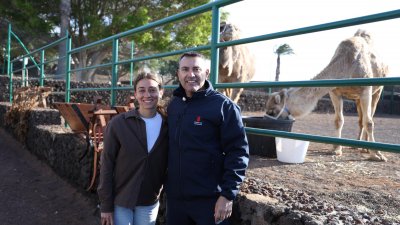
El Cabildo de Lanzarote has announced that its next line of aid to cover operating expenses in livestock farms "will continue to include the camel sector" and has reported that it has allocated more than 310,000 euros to the sector in the last three years.
The first island institution has thus responded to the announcement of the institutional declaration promoted by the Yaiza City Council in support of the camel sector after the campaign Canarian Camels, elaborated by the Fundación Franz Weber and which has already accumulated more than 35,000 signatures to ask for a change in the dromedary excursions on the island.
The president and counselor of Agriculture of the Cabildo, Oswaldo Betancort, has explained that the forecast for 2026 contemplates an increase in aid up to 600 euros per Major Livestock Unit (UGM), an amount that is situated "above the references of previous years and that responds to the need to adjust public support to the real costs of the farms".
As detailed, “this line has remained active as a direct instrument to sustain livestock activity, including those linked to camels, with continuous monitoring of its evolution”.
More than 310,000 euros from the Cabildo in three years
In this regard, the Cabildo has allocated to the camel sector a total of 310,214 euros in the last three fiscal years within this line. In 2023, nine camel breeders were beneficiaries, with a granted amount of 112,360 euros, while in 2024 the figure rose to fourteen professionals and 167,138 euros. In 2025, eleven camel breeders accessed these aids, with an amount of 30,716 euros, in a context marked by the "adjustment of economic intensity" per UGM.
Betancort has pointed out that “this upward revision allows to strengthen the capacity of the farms to face their structural costs and maintain an activity that is part of the island's productive system”.
The president has insisted that the camel sector is part of the productive structure and landscape of Lanzarote, which is why he considers it necessary to maintain specific instruments that allow sustaining its activity. “The data shows a constant line of support, which adjusts each year to the conditions of the sector and that in 2026 takes a step forward in the intensity of the aid to guarantee the continuity of the farms”, he pointed out.
In addition to the economic line, the Cabildo de Lanzarote has announced that it has worked on a package of actions oriented towards dissemination and awareness about the role of the Canarian camel, an indigenous breed in danger of extinction. Along these lines, dissemination initiatives aimed at the population have been developed, focused on its historical, cultural, and productive value within the island model.
Among these actions are included the talks held at the Cabildo's Experimental Farm on the occasion of Field Day, given by Carla Morales, third generation of a camel-breeding family, in which the evolution of the sector and its role in shaping the landscape were addressed. As Betancort indicates, "the camel has been, together with man, a key piece in the construction of Lanzarote's agricultural landscape, and its maintenance also responds to that historical and territorial function."

Add La Voz de Lanzarote as a preferred Google source.
Stay informed with the latest current news.