The Government of the Canary Islands will now argue that the immigrant minors who arrive on its coasts in cayucos or pateras are under police custody, not abandoned or helpless, and are the responsibility of the State, so it has asked the NGOs that manage its reception centers to not accept any more without the express permission of the community.
In announcing this decision, the president, Fernando Clavijo (CC), has specified that this does not mean that the Canary Islands will ignore the minors in this humanitarian crisis, but will continue to help in their reception whenever they have resources available, but as a way of "assisting" the State in its competence.
Clavijo had already announced in the morning that over the weekend things happened in El Hierro that "have marked a before and after". After the meeting of the Migration Pact, he explained it: the Police reported to the Prosecutor's Office the reluctance of an NGO to take in half a dozen minors because they had no places or physical space left after the accumulation of arrivals on the island and the Public Prosecutor sent a legal requirement to his Government.
Having reached that point, he added, the Canarian Executive considers that the protocols are not being followed, which do not foresee that the Police can send the minors directly to the NGOs that manage the autonomous reception centers, and that it is up to him to take measures to protect the workers of these legal entities and of the autonomous community from possible legal risks.
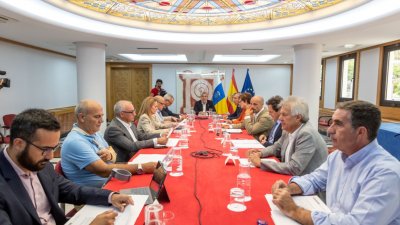
Clavijo has gathered this Monday afternoon, in Las Palmas de Gran Canaria at the table of the Migration Pact of the Canary Islands, the spokespersons of all the parties represented in the Autonomous Parliament -including Vox, which did not sign that agreement nor is part of it- to inform them of what his Governing Council has approved this Monday.
That agreement renews the declaration of migratory emergency (which empowers the administration to make decisions more agilely and quickly than through ordinary procedures) and "promotes" as a "maximum priority" the "agreement" of more reception places and the hiring of more personnel for these tasks, but at the same time requires the State to comply with the protocol established before making available to it new minors arriving in a cayuco.
Its second point is this: "Communicate to the collaborating entities (the NGOs that manage their reception centers) that they do not receive new migrant minors at the expense of this Autonomous Community unless prior communication of conformity or express authorization from the competent autonomous authorities".
And, in addition, it empowers its legal services to "initiate studies and, where appropriate, exercise inter-administrative and judicial actions, including, where appropriate, criminal actions, in defense of the rights of unaccompanied foreign minors, as well as the powers of this autonomous community".
In statements to journalists, Clavijo explained that they have grown tired of hearing for months about this issue "as a problem exclusively for the Canary Islands", when, in his opinion, the reception of foreign minors is the responsibility of the State and they are going to assert it from now on with their position.
The Canary Islands relies on the fact that the law attributes to the autonomous communities the guardianship of those minors who are in their territory in a situation of abandonment or helplessness, circumstances that, in their opinion, do not occur with the children and adolescents of the cayucos, whom the Police affiliates, identifies and guards upon their arrival.
In fact, Clavijo has remarked that the majority of these minors arrive on land rescued by a State service, in allusion to Maritime Rescue, which disembarks them in the Canary Islands "as it could transfer them to Cádiz".
All the political parties of the community, including the PSOE and Nueva Canarias, in the opposition, have expressed their support for the Government of Clavijo in the decision to demand that the protocols be complied with and to protect the workers of the reception centers and of the collaborating NGOs from possible criminal consequences.
In turn, the president has praised the support he is receiving so far in this matter from the Canarian socialists, to whom he has assured that he has no reproach to make.
However, that unanimous support has nuances, because the spokesman of the PSOE, Sebastián Franquis, has remarked that one thing is to protect the workers from legal consequences and another is to undertake a judicial battle with the State with which they do not agree.
"Clavijo has the solution to this problem on his right, in the PP, with whom he governs, who voted against the reform of the Immigration Law," he said. And the spokesman of NC, Luis Campos, has criticized that, this time, the Government of the Canary Islands has made a decision without debating it first with the signatories of the Migration Pact.
For his part, the deputy of CC José Miguel Barragán has indicated that he refuses to believe that, no matter how much "fuss" the migratory issue is causing in the national political debate, there is no one in the main parties of the country who is already looking for ways of understanding to carry out a reform of the law.
In this regard, the deputy of the PP Luz Reverón has indicated that her formation is willing to support legislative measures if the conditions that she has set from the beginning are met: that the State guarantees the financing of the reception, that the migratory emergency is declared for all of Spain, that a Conference of Autonomous Presidents is convened to address this issue and that all the territories are involved in the effort, without exception.


Add La Voz de Lanzarote as a preferred Google source.
Stay informed with the latest current news.