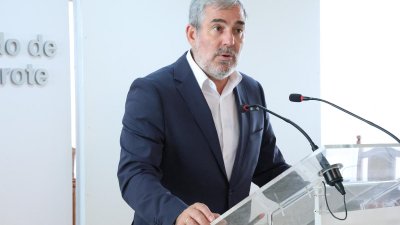
The president of the Canary Islands, Fernando Clavijo, has demanded this Wednesday maximum speed in the application of the "law in force" that launches a national system for the distribution of unaccompanied migrant minors. Clavijo has made a call to the State and the rest of the autonomous communities to "comply and enforce" the new legislative framework so that the "overcrowding" can be ended as soon as possible, which he has assured, is currently suffered by the 5,037 minors hosted in the 85 operational devices in the archipelago.
"Once we have completed the legal structure, there are no more excuses for the law to be complied with, for the law to be enforced and for this serious problem of overcrowding that the Canary Islands suffers today, but that tomorrow can be suffered by the Balearic Islands or the day after tomorrow Andalusia", said the head of the autonomous Executive.
Fernando Clavijo announced that this Wednesday, 24 hours after the approval of the royal decree in the Council of Ministers, that the Canary Islands has already submitted to the State the formal request for a declaration of extraordinary migratory contingency for tripling the 737 minors that the archipelago is responsible for hosting.
Once this procedure has been completed, the head of the autonomous Government asks the State for agility in the procedures to launch the distribution system for migrant minors. In addition, he recalled that from today all migrant minors who arrive on the Canary Islands coasts without relatives will have to have assigned within a maximum period of 15 days the autonomous community to which they are going, which will mean that the archipelago's centers will stop receiving new boys and girls.
In parallel, the decree establishes a period of one year for the more than 3,000 migrant minors in which it exceeds its reception capacity to travel to other communities. "We hope that these deadlines are met so that we do not have to go to court again," said the president after announcing that, for its part, the autonomous Government will reinforce its services with 26 more workers to process in a timely manner the documentation necessary to comply with all procedures.
Clavijo expressed confidence in the country's capacity to welcome migrant minors. According to him, migration is a structural phenomenon "that must be learned to manage and manage it with dignity, and not use it as a xenophobic, racist political tool that often has to do with skin color." "We have managed the arrival of thousands of Ukrainians and yet there has not been this response from the xenophobic populism that is playing with the pain of these children in a petty way simply to scratch a handful of votes," he added.
"We are talking about boys and girls"
Regarding the opposition of some communities to welcome migrant minors, the Canarian president asks the presidents of these regions to "think that we are talking about boys and girls", so he hopes "that they comply with the law and that they comply with it in a way that the integration of these boys and girls is complete." "In a country of 50 million inhabitants, it cannot be a problem to distribute 4,000 minors," he added to emphasize that "whoever wants to generate that debate is doing a disservice to democracy and the rights of children."
The head of the Canarian Government defended the legal solidity of the migrant minor distribution system already underway. He recalled that the Supreme Court "has spoken in three orders very clearly about the situation of overcrowding of unaccompanied migrant minors in the Canary Islands", while the Constitutional Court has considered that "it is a concurrent competence where the autonomous communities have our obligations but also the State has the obligation to guarantee solidarity and above all to protect the best interests of the child."
Fernando Clavijo made these statements after a meeting with the general secretary of UGT, Pepe Álvarez, and other representatives of the union. The president thanked UGT and the entire Canarian society for their support in the "fight" for minors, a success achieved after two years of negotiation that he attributed to the fact that the archipelago has defended the rights of these boys and girls with a single voice.
Also the number one of the union praised the work done by the Government of the Canary Islands in migratory matters, in addition to demanding from the rest of the autonomous communities solidarity and humanity to comply with the rights of children.
The capacity of the archipelago: 737 minors
The Government of the Canary Islands has officially requested this Wednesday from the president of the Sectoral Conference on Children and Adolescents the declaration of extraordinary migratory contingency of the archipelago by far exceeding three times its ordinary capacity. The Minister of Youth and Childhood has this request on the table one day after the Council of Ministers approved the royal decree that culminates the legislative process to launch the distribution of unaccompanied migrant minors among all the autonomous communities.
This Royal Decree 743/2025, already in force after being published this Wednesday in the Official State Gazette (BOE), establishes the ordinary capacity of the protection and guardianship system for unaccompanied foreign minors of the autonomous communities and cities with Statute of Autonomy. In the case of the Canary Islands, this ordinary capacity is set at the reception of 737 boys and girls.
However, the Canary Islands currently attends to 5,037 unaccompanied migrant minors, which far exceeds the requirement established by the royal decree for an autonomous community to request the declaration of extraordinary migratory contingency: exceeding three times its ordinary capacity, which in the case of the archipelago is 2,211 boys and girls when multiplying 737 by three.
Three decrees
The request of the Canary Islands for a declaration of extraordinary migratory contingency comes after a year and a half of work and political battle by the Government of Fernando Clavijo to achieve a change in the Immigration Law that guarantees the distribution of unaccompanied migrant minors among all the autonomous communities.
After declaring the migratory emergency on August 1 and reaching the tutelage of nearly 6,000 migrant minors, the Executive opened a negotiation with the State to achieve a legislative change and alleviate the pressure and overcrowding of the reception system that the islands' reception system has been suffering for more than a year and a half.
As a result of that work led by President Fernando Clavijo, the Council of Ministers approved on March 18 a first royal decree that introduced a new eleventh additional provision in the Immigration Law of 2020 to launch a system of mandatory distribution of migrant children. In that provision, the ordinary capacity of the protection and guardianship system for unaccompanied foreign minors was regulated for the first time in history and technical criteria were established for their distribution among the autonomous communities.
Next, on July 22, the Council of Ministers approved a second royal decree in which it established the process for the declaration of a situation of extraordinary migratory contingency, and that the resolutions would be issued by the person holding the Presidency of the Sectoral Conference on Children and Adolescents, the minister of the area.
Finally, the royal decree approved this Tuesday and which has entered into force this Wednesday approves the ordinary capacity of the protection and guardianship system for unaccompanied foreign minors of the autonomous communities and cities with Statute of Autonomy, in accordance with the provisions of the eleventh additional provision of Organic Law 4/2000, of January 11, on the rights and freedoms of foreigners in Spain and their social integration.



Add La Voz de Lanzarote as a preferred Google source.
Stay informed with the latest current news.