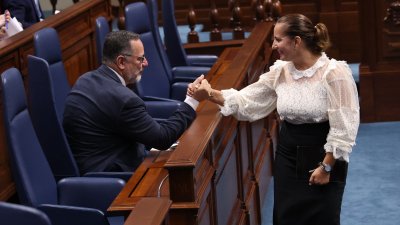
The Parliament of the Canary Islands has approved this Wednesday -with the sole rejection of Vox- the Non-Law Proposal (PNL) presented by the Popular Parliamentary Group to **protect, promote and disseminate the linguistic expressions of the Canary Islands** as an essential part of the Archipelago's cultural heritage.
The initiative, defended by the deputy for the island of Fuerteventura, María Saavedra, recognizes that the Canary Islands possess a unique cultural identity, forged through centuries of history, marked by insularity, cultural mixing, and the coexistence of diverse traditions.
Among the main hallmarks of this identity are the ways of speaking, expressions, words, and constructions unique to each island, which reflect the way the Canarian people understand and live life.
"The only thing we defend with this NLP is that Canarians speak as they feel. With our words so that the words of our grandparents reach all the grandchildren clearly," Saavedra stated from the podium of the Plenary Hall."So that the Spanish of the Canary Islands is not lost. For the *magua*, the *jeito*, and the *maresía*. For the *perenquén* and the *murgaño* that watch the *folelé* fly. For the *arroró* that puts the *chinijo* to sleep. For the *vidriolas* and marbles that my father carried in his suitcase. For the *guineo* of the gossiping women who fan themselves in the shade. For a *jacío*, a *queque*, a *buche* of coffee, and good company. So as not to forget what we are, or where we come from. For the promotion, protection, and dissemination of the linguistic expressions of the Canarian dialect," added the Majorera deputy.
The approved text highlights that these expressions are a tool for intergenerational cohesion, uniting the elderly, young people, and children in the same way of communicating and transmitting values. Expressions that today are at risk of disappearing due to factors such as population growth, inter-island mobility, and changes in communication habits.
Faced with this situation, the PNL urges the Government of the Canary Islands to develop, in collaboration with the public universities of the Canary Islands, the Canarian Institute of Cultural Development, and local corporations, a plan for the protection and promotion of the linguistic expressions of the Canary Islands. This plan must include, make visible, and disseminate the popular linguistic heritage of the different islands, paying special attention to those expressions at risk of being forgotten.
María Saavedra recalled that article 37 of the Statute of Autonomy of the Canary Islands establishes that public authorities assume fundamental issues such as the defense, promotion, and study of the Spanish of the Canary Islands as guiding principles of their policy,” while emphasizing that UNESCO believes that regional dialects should be protected as living elements of cultural diversity. "Our responsibility is to adopt measures that curb its loss and transform it into an educational, cultural, and social opportunity. Defending the Spanish of the Canary Islands and our Canarianisms is not nonsense. Our way of expressing what we feel or think belongs to us and identifies us. Like our flag or our anthem. It is not the exclusive heritage of anything or anyone," said the Majorera deputy of the Popular Group.
Video on the protection of Canarianisms
Saavedra had prepared a one-minute video to promote the exhibition, highlighting numerous Canarianisms shared by Canarians of all ages.
However, according to the internal regulations of the Parliament of the Canary Islands, it could not be broadcast in the Plenary Hall, although it will be shared on the social networks of the Popular Party of the Canary Islands and through the media.
Add La Voz de Lanzarote as a preferred Google source.
Stay informed with the latest current news.